
“Any government that promises
to rob Peter to pay Paul can always
depend on the support of Paul.”
GEORGE BERNARD SHAW
Last Tuesday night, Treasurer Jim Chalmers handed down one of the most unpopular budgets in Australia’s history. He claimed the Budget was about fixing intergenerational inequality and making housing more affordable for first-home buyers. Tell him he’s dreaming.
For starters, the term “intergenerational inequality” is a social construct dreamed up by Labor to create a whole new class of victims they can encourage to vote for them. Yes, young people have challenges, as young people always have, but so do older Australians.
As for affordable housing, it’s fast becoming a pipe dream. Even the Budget papers forecast housing prices will rise by 4% over the next year. A tax cut worth roughly $50 a week for younger workers is hardly going to help much when mortgage repayments keep climbing as interest rates rise. There also seems to be an assumption that the best way to increase housing supply is to make investing in residential property by individuals as unattractive as possible. Clearly, they’ve never heard the adage: “Money flows to where it’s treated best.”
Talk to any builder, and they’ll tell you they’re overworked, prices are going sky-high, and they can’t get staff. Furthermore, they’re held down by a web of red tape and bureaucracy. Just this week, a builder told me he had a block of apartments all set to go, but couldn’t get the plan registered until the Brisbane City Council lodged their landscaping certificate. Can you believe it took the Brisbane City Council 12 weeks to lodge a simple certificate? That was 12 weeks of wasted time, which he said cost him over $200,000 in delayed settlements.
I can’t see building prices dropping in this environment.

PODCAST
Making Money Made Simple
with Noel Whittaker
Renowned broadcaster John Deeks and I discuss all the big topics covered in this newsletter in detail each month.
A history of reckless spending
Anybody who has seen the brilliant ABC series Utopia knows how modern government works. The priorities are the quick fix and the political sugar hit, while long-term consequences are either ignored completely or kicked down the road for somebody else to deal with. Too often, policy is built around the next news cycle rather than the next generation.

Picture a make-believe Cabinet meeting during a crisis where somebody says: “People are hurting. Let’s cut fuel excise and give everyone 30 cents a litre relief.” A wise prime minister might reply: “Do we really want to borrow another $3 billion for a temporary feel-good measure while pushing the national debt even higher? Perhaps Australians should simply weather this one themselves.” But that’s not how modern politics works: borrowing money to buy votes has become the norm. Only debt never disappears, it gets handed to the next generation with interest attached.
That’s the real intergenerational inequality, and it has been building for years, with COVID pouring petrol on the fire. Morrison panicked, the Reserve Bank slashed interest rates to emergency levels and Canberra spent money as though there was no tomorrow. JobSeeker became so generous that hospitality businesses complained staff were better off staying home than returning to work.
The perfect storm
After COVID ultra-cheap money and massive government spending created the perfect inflationary storm. House prices exploded, wages failed to keep up, and younger Australians were left trying to save a deposit while competing against a flood of cheap money. We are still paying the price today.
One of the biggest reasons for the jump in housing prices has been the endless stream of government incentives for first-home buyers. Allowing people to borrow with a 5% deposit, avoid mortgage insurance and qualify more easily for a loan pushed prices even higher. More interest rate rises could easily push some recent borrowers over the edge and force sales, which would finally start to put a brake on the market. Every rate rise also reduces borrowing capacity and therefore acts as its own brake on prices.
The housing market has always been about supply and demand and, now that changes to capital gains tax and negative gearing are looming, it is not hard to work out what happens next. Anyone currently negatively gearing an investment property will be reluctant to sell, while anybody sitting on a large, unrealised capital gain will be equally reluctant to let go. The result will be fewer properties for sale, tighter rental markets and higher rents, which always hit the most vulnerable hardest.
The key to property success – add value
What many people fail to understand is that the real key to success in property is buying well, ideally by purchasing an undervalued property from a motivated seller and then adding value over time. In today’s market, with soaring construction costs and chronic shortages of labour and materials, only a very brave investor would build a new property. In many cases, the only realistic option is a house in a giant cookie-cutter estate where every second property looks the same.
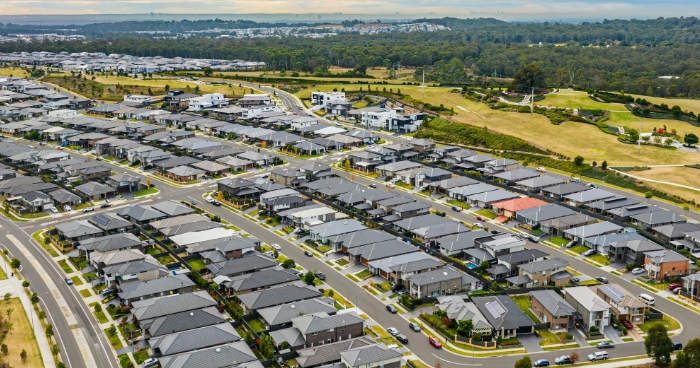
Image by Shanjir H | Photo4life AU on Unsplash
Obviously, a better choice for a would-be property investor is to buy an older, established home in an up-and-coming area and hope the location will drive future value. But here’s the problem: to add value, repairs and improvements are often needed. If negative gearing on established properties disappears, those repairs will have to be funded from after-tax dollars, with the owner praying they will recover the benefit years later through capital growth. Who in their right mind would do this? I predict fewer investors, fewer rental properties and higher rents, with poorer Australians once again wearing the pain.
It will also be a bonanza for property spruikers, whose pitch never changes: cash in the bank is useless, shares and superannuation can’t be trusted, so the only safe investment is property. Thanks to the new rules, the only way to obtain negative gearing benefits now is to buy a new property and, conveniently, the spruiker has one ready to go. The inexperienced investor is now on the hook. The spruiker organises the finance, the paperwork and, if you are short of cash, may even encourage you to start a self-managed super fund and roll your super into the deal, which is one of the fastest ways imaginable to destroy your retirement savings and financial future.
Priorities!!
The budget gives us a look into the government’s real priorities. Nothing for poorer older people who rent and are not allowed to earn much money working, because of the way the Centrelink rules are arranged. But they’re happy to allocate $50.4 million in 2026–27 to continue to support the prosecution of war crimes alleged to have been committed by the Australian soldiers in Afghanistan.
On Monday night Channel 10 reported that the government has just cut a $5,000 annual allowance to Doug Baird, father of Corporal Cameron Baird VC, who was posthumously awarded Australia’s highest military honour for his actions in Afghanistan in June 2013. Cameron Baird was killed in action that year.

Doug has been using the allowance to honour his son’s memory through various commemorative activities. When he tried to arrange a meeting to discuss the matter, he received a blunt message instead. “I was shocked to hear the actual bluntness of the whole lot of it,” Doug told 3AW Mornings. “That meeting never happened.”Former Senator Michael Ronaldson, who originally gifted the allowance to the Baird family, called in to voice his anger. “This just seemed to me to be an appalling, mean-spirited decision,” he said.
Responsibility, productivity and fairness!!
The Treasurer says this Budget is about responsibility, productivity and fairness. Fine words, but the reality looks very different. The headline measures are attacks on negative gearing, higher taxes on capital gains and yet another round of government spending dressed up as reform. Yes, the deficits are slightly smaller, but that has far more to do with windfall revenue flowing into Treasury coffers than genuine fiscal discipline or tough decisions by government.
At the very time the Reserve Bank is trying to crush inflation and bring spending under control, this Budget continues pumping money into the economy, which simply makes the RBA’s job harder and increases the risk that interest rates stay higher for longer. Younger Australians trying to buy homes will ultimately pay the price through larger mortgage repayments.
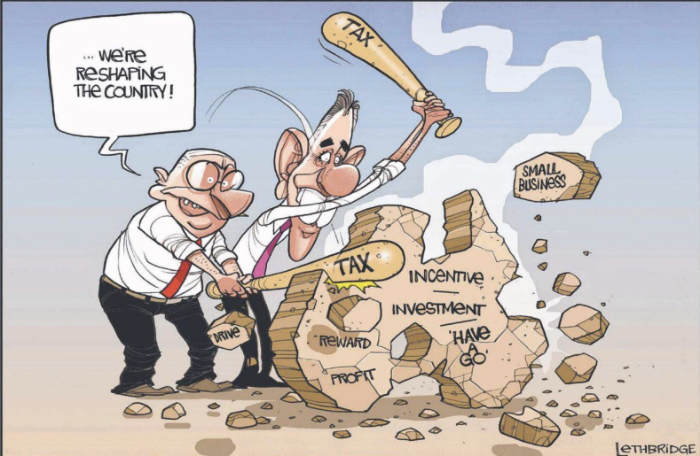
Cartoon by Brett Lethbridge
The bigger problem is structural. Government spending keeps rising, deficits are forecast for years ahead, and national debt continues climbing with barely any discussion about how it will be repaid. Canberra now behaves as though borrowed money is normal, permanent and without consequences, though every extra dollar of debt pushes the burden onto future taxpayers.
This is not genuine tax reform. It is largely a tax grab with a fancy label attached. Real reform would simplify the tax system, reduce red tape, encourage investment and improve productivity.
The major tax changes
Capital gains tax
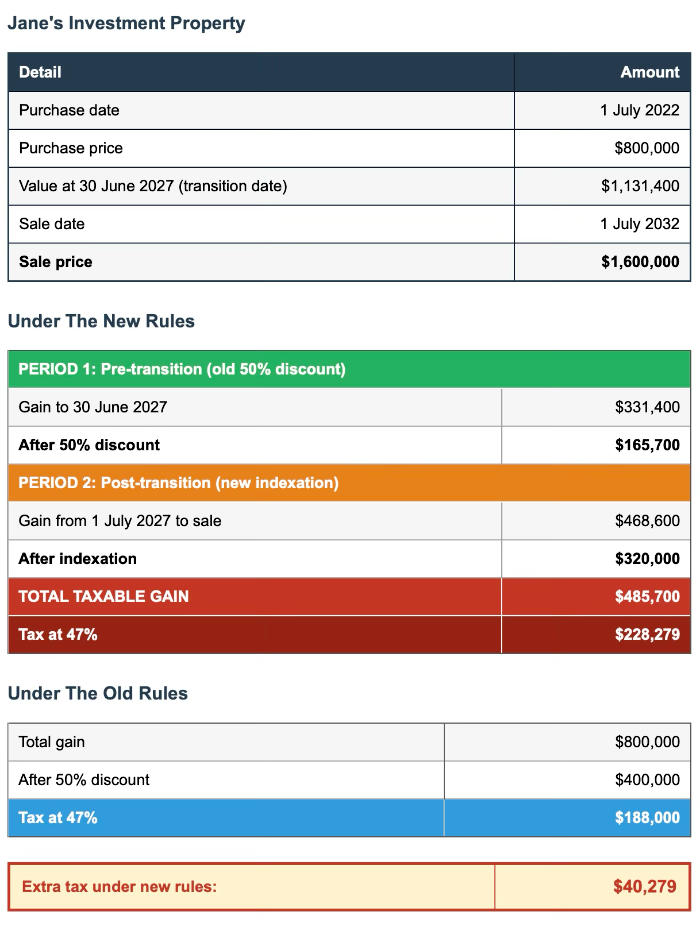
They claim the changes have been grandfathered, but in my view they are only partly grandfathered. Suppose you own a property now worth $800,000 that you bought 10 years ago for $400,000. You will get the 50% CGT discount if you sell the property by 30 June 2027. But if you sell after that date, two sets of rules will apply. A case study may make this clearer.
This example is from the Budget papers, but the numbers have been rounded to make it easier to understand. Jane buys a property on 1 July 2022 for $800,000. She sells it on 1 July 2032 for $1.6 million. Using what the department calls “ATO tools”, she discovers the asset was worth $1,131,400 on 30 June 2027, when the transition came into effect.
The difference between that value and her original cost price is $331,400, which reduces to $165,700 after applying the 50% discount. She then subtracts the 30 June 2027 value of $1,131,400 from the selling price of $1.6 million. This gives her a gain of $468,600 from 1 July 2027 until the property was sold on 1 July 2032. After indexation from 1 July 2027 until the sale date, the adjusted gain would be $320,000.
The total taxable gain is then the sum of $165,700 and $320,000, giving a taxable capital gain of $485,700, which would be added to her taxable income in the year of sale. The tax payable would depend on her other income, but if we keep it simple and apply the top marginal rate of 47%, the total CGT bill would be about $228,279.
Under the old rules, her gain would have been $800,000, which, after the 50% discount, would have reduced to $400,000. Tax at 47% on that amount would have been $188,000, which is about $40,000 less than under the proposed new rules.
I appreciate this is complex, which is why it is so important to get expert advice if you are even thinking about selling a CGT asset. They’re summarized in this table to help you understand how it works.
Special treatment for pensioners
The $1 Pension Loophole
The Budget exempts anyone receiving even one dollar of “income support” from the new CGT rules. That includes pensioner couples with $1.054 million in assets who get a few dollars a fortnight in pension. They keep the full 50% CGT discount. No questions asked.
These same couples can earn $90,000 a year from work without losing a cent of pension. A single renter with no assets is treated in the harshest way imaginable.
Meanwhile, meet Jenny. She’s 67, rents for $400 a week, and has no assets apart from a few dollars in the bank. She gets the full single age pension of $30,654 plus rent assistance of $5,616, giving her a total income of $36,254 a year. She considers a job paying $45,000. Sounds good, right?
Here’s what actually happens. Once her income exceeds $218 a fortnight, she loses 50 cents of pension for every extra dollar earned. The Work Bonus gives her some temporary relief in year one, but after that it’s gone. Her $45,000 salary costs her $13,780 in lost pension. Add $10,516 in tax, and the combined hit is $24,296. She’s working full-time for an extra $20,704. That’s an effective marginal tax rate of 54%. No-one else in Australia pays tax at that rate.
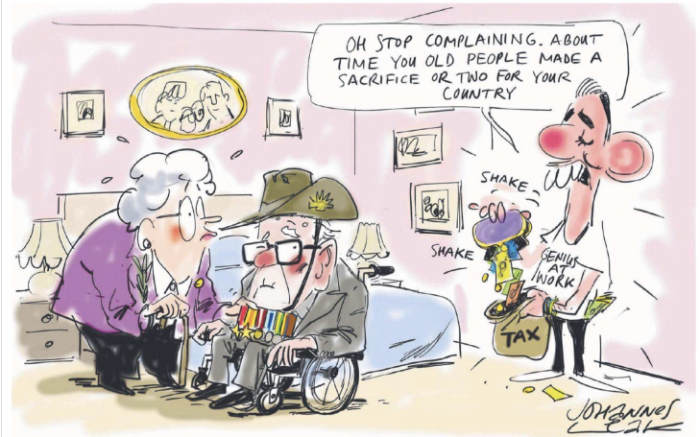
Cartoon by Johannes Leak for The Australian
But a couple with over a million dollars in assets? They can earn $90,000 with zero impact on their pension—and now they’re protected from CGT changes too.
The system protects the wealthy and punishes the poor. This Budget just made it worse.
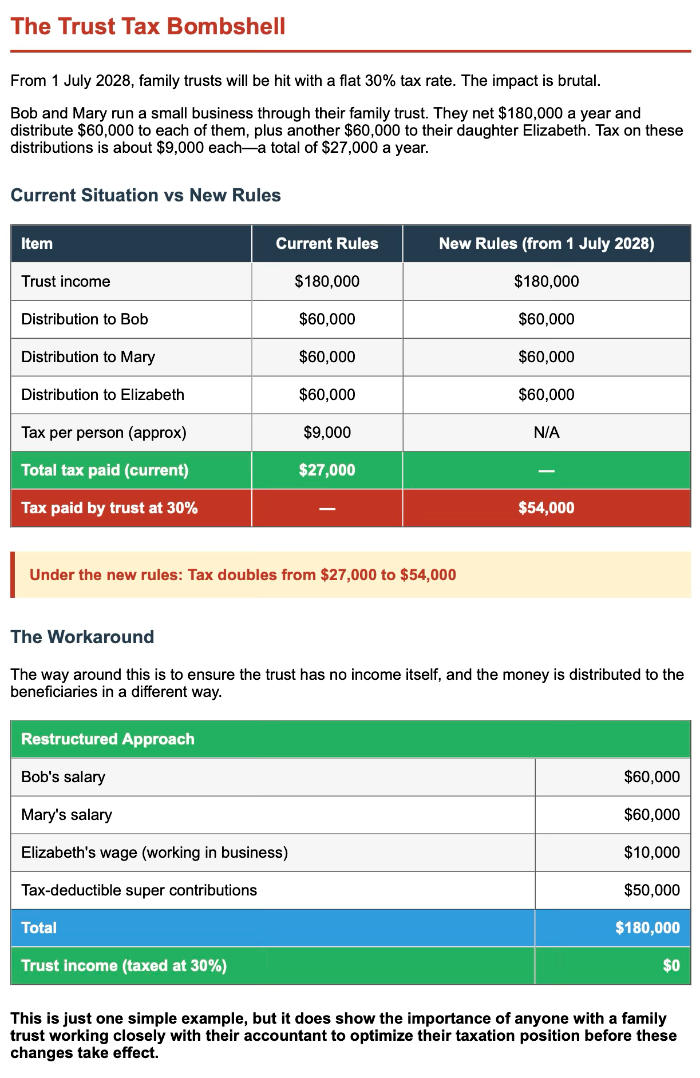
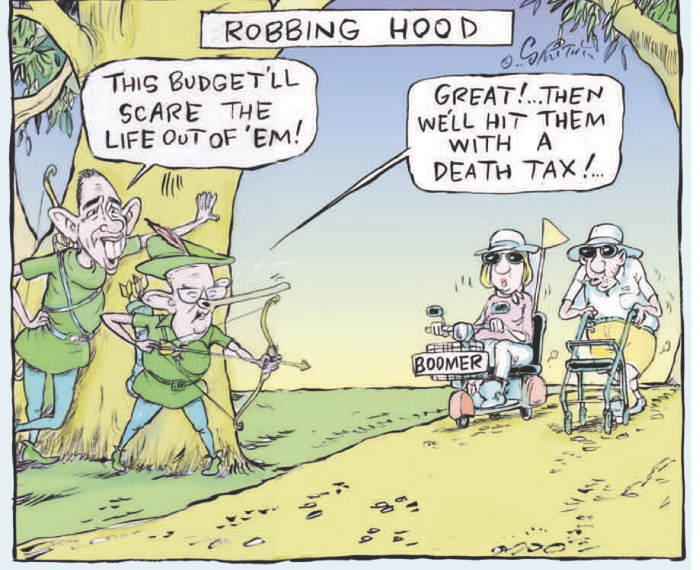
The Death Tax
There’s been plenty of media speculation about a possible death tax. Much of it appears to relate to potential changes to testamentary trusts, but that remains a grey area and experts are still waiting for details. But there is already a form of death tax effectively locked in: Division 296, the proposed tax on super balances above $3 million.
Take Jack and Jill. They each have $2.5 million in super, so neither is affected because both are under the threshold. Then Jack dies and his super passes to Jill, pushing her balance to $5 million and leaving her $2 million above the threshold and potentially exposed to Division 296 tax.
A death tax by stealth.
Advice on tax
If you are worried about how the new rules may affect you, there’s a useful service run by the team at Ask Ban TACS where qualified tax experts answer questions with references you can take back to your accountant. A basic question costs $129 and a complex one $259. One recent “complex” question reportedly saved a reader $292,000 in tax through the small business CGT concessions and marriage breakdown rollover provisions — not a bad return on investment.
Private health insurance rebate
The decision to slash the private health insurance rebate for older Australians has been dressed up as “intergenerational equity”, but the reality is very different. Older people who keep private health insurance actually save the government money because they help fund part of their own healthcare instead of relying entirely on the public system. That benefits every generation.
It makes economic sense to encourage pensioners and lower-income self-funded retirees to stay insured. Public hospitals already face massive waiting lists for elective surgery, and Australians are hardly likely to support extra charges to use them. The more older Australians who remain in the private system, the less pressure on taxpayers and the public health system.
From 1 April 2027, a couple aged over 70 paying $7,000 a year in premiums could be around $830 worse off each year according to National Seniors’ new rebate cut estimator.
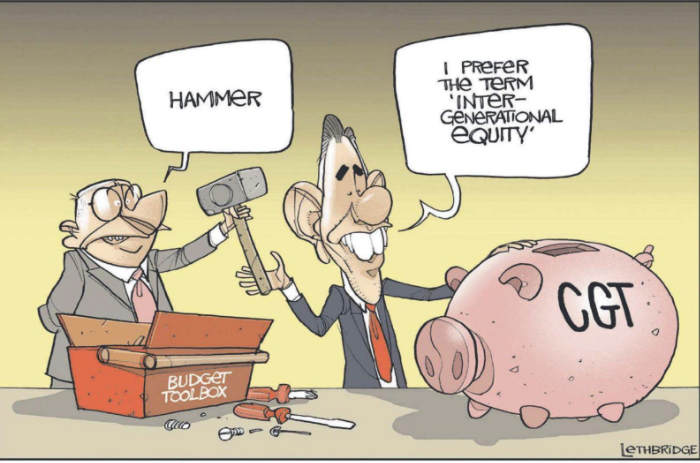
Cartoon by Brett Lethbridge
Instead of carefully redesigning the rebate to keep older Australians insured, the government has taken a sledgehammer to the system. The likely result? Tens of thousands of older Australians will drop their cover altogether, while those who remain face even higher premiums. Actuaries say it’ll cost public hospitals $547 million extra.
So they slugged the elderly, gutted private health, and lost money doing it.

I hope you have enjoyed the latest edition of Noel News.
Thanks for all your kind comments. Please continue to send feedback through; it’s always appreciated and helps us to improve the newsletter.
And don’t forget you’ll get more regular communications from me if you follow me on X – @NoelWhittaker.
Noel Whittaker
Featured image from Unsplash