

“Life is like a ten-speed bicycle.
Most of us have gears we never use.”
CHARLES M. SCHULZ
Welcome to spring and our September newsletter
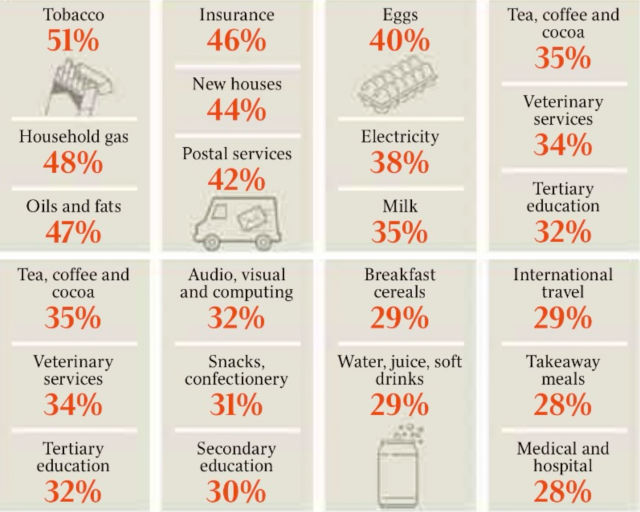
Spring is supposed to be a time of renewal, when the garden comes alive and everything starts looking brighter. Unfortunately, the economic landscape is not nearly as cheerful. Markets remain unsettled, the war in Iran that was supposed to be over in eight weeks seems to be dragging on forever, and the property outlook is deteriorating as the effects of the May Budget ripple through the country. Meanwhile, Christmas is approaching and the cost-of-living squeeze is still hitting families hard.
Feeling the Squeeze
Price increases from June 2021 to June 2026
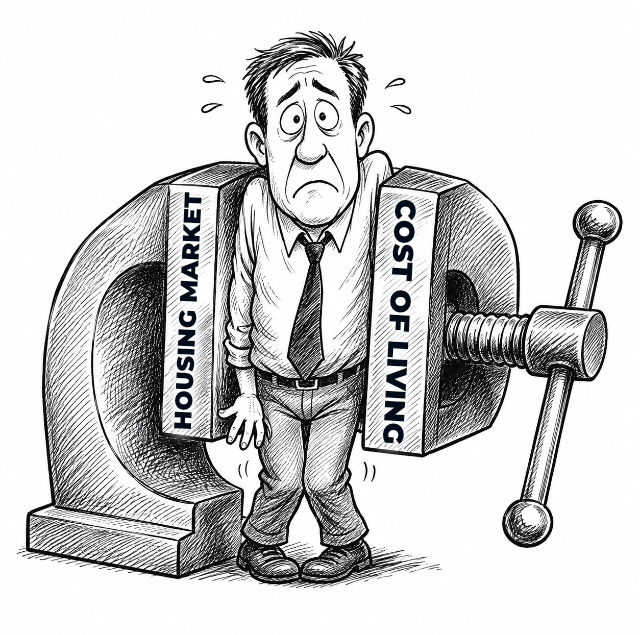
The collapse of Sydney developer Bathla Group is a warning that Australia’s housing crisis may get worse before it gets better. Bathla has debts exceeding $3.2 billion, around 2,000 homes under construction and another 13,000-plus in the pipeline. Administrators are desperately seeking emergency funding to keep projects moving.
The ramifications go far beyond Bathla. Subcontractors and suppliers owed millions may themselves fail, buyers face delays and uncertainty, and private-credit lenders are exposed. Most importantly, thousands of desperately needed new homes could be delayed or never built. At a time when Australia already has too few homes, this is the last thing we need.
But whenever we talk about “the property market”, remember there is no such animal. Australia has hundreds of property markets, from Cairns to Perth, from houses to apartments, and each is moving through its own cycle.
Having said that, there is no doubt sentiment has changed. Investors have lost enthusiasm as the consequences of the May Budget continue to sink in. Vendors are reluctant to list because they realise they may not get the price they expected six months ago, while buyers are equally wary of signing a contract today in case prices fall further tomorrow.
That combination — reluctant sellers, nervous buyers and disappearing investors — is hardly a recipe for a healthy market.

PODCAST
Making Money Made Simple
with Noel Whittaker
Renowned broadcaster John Deeks and I discuss all the big topics covered in this newsletter in detail each month.
Credit card surcharges to go on 1 October
The financial landscape will change again on 1 October, when credit card surcharges are banned. The ban will apply to debit and credit cards, including Visa and Mastercard, with American Express and Diners Club the only exceptions.
These surcharges have been costing consumers around $1.8 billion a year, so their abolition sounds like good news. But there is no free lunch. The big question is: who will ultimately pay the $1.8 billion?

There are really only two possibilities. Retailers will absorb the additional cost and recover it through higher prices, or the card providers will claw back some of the benefits they currently offer customers. Those benefits could include frequent flyer points, rewards programs and free travel insurance.
The coffee shop owners I have been speaking to are in little doubt about what will happen. They say the cost will almost certainly be recovered by increasing the price of coffee, food and other items they sell. In other words, instead of seeing a surcharge on the bill, we may simply pay more for the product. And, of course, that adds yet another little push to inflation.
For now, it is a matter of watching what happens and seeing how individual businesses respond.
But spare a thought for small business owners. I’m told that around 5,000 coffee shops and restaurants have gone broke in New South Wales in the last two months. It’s not hard to understand why so many small businesses are under enormous pressure.
It’s a sad fact of life that many struggling businesses have traditionally used the Tax Office as a kind of ATM, delaying tax payments when cash flow gets tight and paying compulsory superannuation when they are able to. From 1 July, however, super has had to be paid as part of payroll. With compulsory super now at 12% of wages, that has effectively brought forward a substantial cash-flow burden for every small business.
Add rising wages, rent, electricity, insurance and the general cost of doing business, and then tell a café owner that another cost must simply be absorbed. Something has to give.
The surcharge may disappear from the receipt on 1 October, but don’t imagine the cost has disappeared with it. We may simply end up paying for it somewhere else.
Treasury backs off discretionary trusts
Just as I was signing off this newsletter, some good news arrived from Treasury. It appears to have backed down on its proposed treatment of discretionary family trusts – but don’t celebrate just yet.

To avoid the proposed 30% minimum tax, trustees would be able to elect to direct a fixed proportion of the trust’s income to specified beneficiaries. The problem is that once the election is made, it cannot be revoked.
Think about what that means. A family makes an election today based on circumstances today. Five years later, one beneficiary is diagnosed with a terminal illness and desperately needs additional financial support. Another may have lost their job, suffered a business failure or gone through a marriage breakdown. Yet the trustee’s hands are tied by an election made years earlier.
And here’s the absurdity: once income must be distributed in fixed proportions to specified beneficiaries, a discretionary trust is no longer truly discretionary.
Treasury has recognised that its original proposal went too far, which is welcome. But the proposed solution remains far too rigid. The great strength of a discretionary family trust is its ability to respond when family circumstances change. Take away that discretion and you undermine the very reason these trusts exist.
Superannuation under attack
Superannuation has suddenly become everybody’s favourite pot of money.

Last month Prime Minister Anthony Albanese said there was “real potential” to see our super funds as “a national asset” that could produce better returns not just for individuals and retirees, but “for the nation”. That immediately raises the question: whose money is it? Pauline Hanson has come at it from the opposite direction: “It is their money.” With Australians struggling with mortgages and the cost of living, she believes the rules should be loosened so people can get their hands on more of their super when they need it.
Then there’s the Liberal Party. Opposition Leader Angus Taylor leads a party that has already advocated letting Australians use their super to help buy a home. On television last Monday night he went further: “It’s the people’s money. They should be able to do what they like with it.” And then, almost inevitably, the aptly named Senator Andrew Bragg weighed in, declaring superannuation one of the biggest public policy failures since Federation.
So now we have three very different approaches to the same $4.5 trillion pot of money. The Prime Minister sees it as a national asset. Pauline Hanson wants people to have greater access to it. The Liberals say it’s the people’s money and they should be able to decide what to do with it. It’s a debate worth having, because behind all the politics lies one fundamental question: whose money is your superannuation?
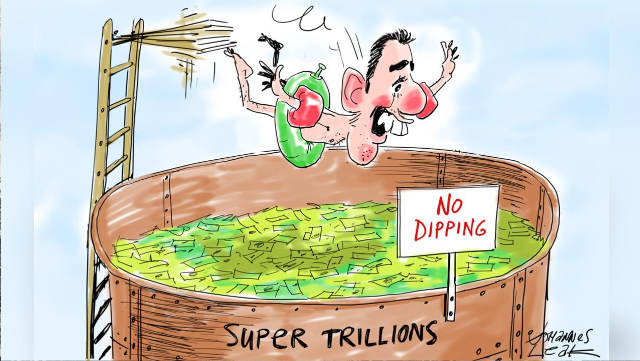
Image by Johannes Leak
To answer that, let’s go back to the architect of our modern superannuation system, former Prime Minister Paul Keating. He once told me: “I wanted an Australia where every worker would have money put away for their retirement, professionally managed so they could benefit from compound interest, and protected until they reached preservation age.” It was a simple idea, but its impact has been profound.
In the early 1990s compulsory employer super started at just 3%. Over the years it was gradually increased, with the final step to 12% reached only last year. It was hardly a smooth journey. There were repeated attempts to stall the increases and, at one stage, enormous pressure to freeze the guarantee at 9%. Fortunately, the system survived, and millions of Australians are better off because it did.
I’ll never forget an email I received from a 66-year-old woman. “I have no home, and my only asset is $250,000 in super. How will I cope in retirement?” I explained that at 67 she would qualify for an indexed age pension of around $30,000 a year for life and could also draw about $18,000 a year from her super – enough to last until at least 90. Her reply said it all: “Thank you. You’ve put my mind at rest.” For people like her, super means choices, dignity and independence.
Critics of compulsory super have always argued that workers would be better off getting the money now instead of having it locked away for decades. It sounds attractive, but it ignores one basic fact: human nature. People adapt their spending to whatever lands in their bank account. They don’t miss the 12% going into super any more than they miss the tax withheld from their wages. But they certainly notice that money when they retire.
Take a 40-year-old earning $55,000 a year who already has $100,000 in super. Their employer contributes $6,600 a year. If that money were paid as wages instead, tax would take 30% and the rest would almost certainly disappear into everyday spending. Without compulsory super, much of that money would simply vanish over a lifetime, leaving the age pension to do far more of the heavy lifting.
Now leave the money in super. Assume wages rise by 3% a year and the fund earns an average 8%, and by 65 our worker could have around $1.3 million in super. Of course, $1.3 million in 25 years won’t buy what $1.3 million buys today. At 2.5% inflation, it would be worth roughly $700,000 in today’s money. But that’s still $700,000 of retirement wealth that probably would never have existed.
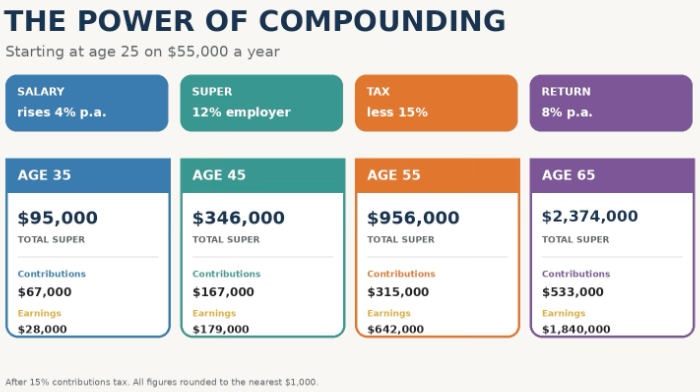
And that is the genius of compulsory super: it happens automatically. The money is invested before it can be spent, compound interest is given decades to work its magic, and people who may never have thought of themselves as investors can reach retirement owning a substantial portfolio.
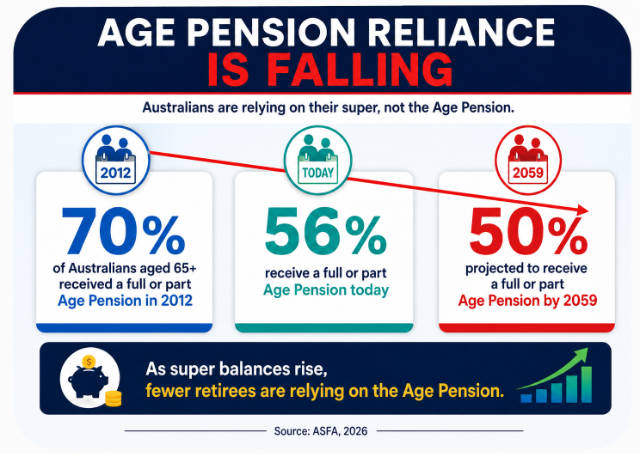
What people seldom talk about is the way that compulsory superannuation is reducing reliance on the age pension, with a great reduction in the amount government spends on welfare.
There are, however, two ways super can sensibly be used to help people into their first home without simply turning it into an ATM.
The first was the Liberal proposal to allow first-home buyers to take up to 40% of their super, capped at $50,000, to help with a deposit. The important part was that the money was not simply gone forever. When the home was eventually sold, the amount withdrawn would be returned to super, together with a share of the capital gain. In other words, it gave young people a leg up into the housing market while protecting their retirement savings.
The other is the existing First Home Super Saver Scheme. This works differently. Prospective first-home buyers make extra voluntary contributions to super, taking advantage of its concessional tax treatment, and can later withdraw eligible contributions plus associated earnings to help fund their deposit. Up to $15,000 of eligible contributions from any one financial year can count towards the scheme, with a maximum of $50,000 available for release, plus associated earnings.
The crucial thing about these proposals is that they do not simply raid the compulsory super put away for retirement. One effectively lends them some of their super to buy a home and requires it to be restored later; the other uses super as a tax-effective vehicle to build a deposit. Both preserve the basic principle of keeping super to fund retirement. That’s very different from opening up everybody’s super whenever money gets tight.
That’s why we should be very careful when politicians start eyeing that $4.5 trillion pot. It may be called a national asset. It may be tempting to raid it for housing, mortgages or today’s cost-of-living pressures. But Keating’s original principle remains the right one: superannuation is the worker’s money, put aside for one purpose – to give them a better retirement.
Once we start treating it as money for anything else, we risk destroying the very thing that made it work. Superannuation is more than economic policy. It’s a social contract. It asks people to give up a little today so they can have much more tomorrow. And its great strength is beautifully simple: it happens automatically.
The widow’s tax
Sometimes a small event starts a cascade and problems escalate. A classic case was the woman who checked her bank balance at an ATM and was told she had $30. She withdrew the $30, unaware that a $2 balance enquiry fee had already reduced her account to $28. The withdrawal pushed her into overdraft, triggering another $30 fee. Suddenly, a woman who thought she had $30 owed the bank money.
The story made headlines across the country and caused such an uproar that the rules surrounding ATM fees and overdrafts were changed. One tiny transaction had exposed a system that was simply unfair.

We may be watching the same sort of cascade now with the Government’s new tax rules.
Senator David Pocock, an ardent opponent of these new rules, has highlighted the case of a 44-year-old domestic violence survivor negotiating a divorce settlement. She had planned to keep an investment property she had owned for more than 15 years. Her solo finance was pre-approved. Then the tax rules changed and the approval was withdrawn.
Three lenders have since rejected her refinancing – not because of her income, credit record or the value of the property, but because of the new negative gearing rules. She may now be forced to sell the asset she has spent years building for retirement. Pocock says family lawyers in Canberra are reporting similar behaviour from lenders, with the new rules already affecting family law settlements.
And what is the Government’s response? Basically: we’re looking into it. Changes may be made later in the year.
But that’s not the end of it. The legislation has become so complex that even tax experts are struggling to work out what it means. It’s hard to resist the conclusion that nobody in Treasury fully understands the monster they’ve created either.

Take family trusts. One obvious question is whether a discretionary family trust will be able to get a refund of excess franking credits under the new rules. You would think the answer would be a no-brainer. Of course it would.
But when I put the question to Treasury, the answer was anything but clear. A spokesperson said the Government’s consultation paper had “sought views” on the treatment of excess franking credits remaining after the trustee had met its tax liabilities. The consultation period closed on 31 July and the Government is considering the feedback. In other words, these laws have been rushed through and we still don’t know the answer to a basic question about how they will work.
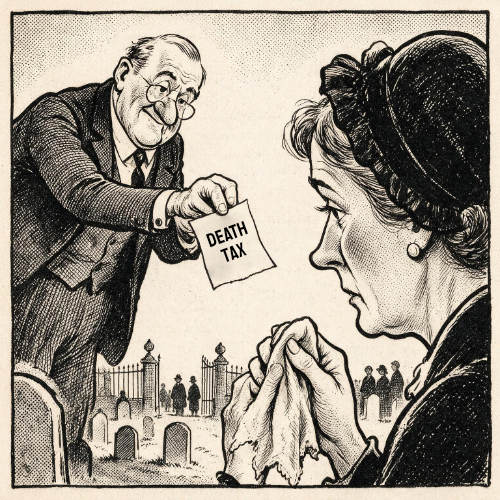
And then there is the new CGT “realisation event” definition, which looks set to become a widow’s tax.
An email from a reader highlights the problem. He wrote: “My understanding is that a death after 1 July 2027 does not create an immediate CGT liability. The beneficiary can still inherit the shares in specie and pay CGT only when they are eventually sold.
“Yet your articles say the opposite – that a death after 1 July 2027 can trigger an immediate CGT liability in the estate. You are the only commentator I have found taking that view, and I would have expected far more public outcry if this really amounted to a secret death tax. I can only hope I have misunderstood you or, heaven forbid, that you are wrong.”
Fair question. So I went back to tax expert Julia Hartman of Bantacs, who confirms that what I wrote is correct under the legislation as it currently stands.
On 4 August 2026, the Government released draft legislation containing proposed corrections, but unfortunately none that fixes this problem. There are, however, cryptic comments in the explanatory memorandum acknowledging problems with rollovers and indicating they may be dealt with in future amendments. At least that suggests the Government is aware of the issue.
The reason it has received so little media attention is simple: the legislation is extraordinarily technical. But that makes it even more important to keep the issue in the spotlight and pressure the Government to fix it. It is astonishing that such an important defect was not corrected in this latest round of amendments.
Here’s the problem in plain English.
To preserve the 50% CGT discount on gains accrued up to 1 July 2027, the legislation effectively deems a CGT event to have occurred at that time. The tax is not payable immediately because another provision defers payment until a “realisation event” occurs.
And that’s where the trap lies.
The definition of a realisation event is extraordinarily wide and includes just about any change of ownership. Death is one of those events because, when you die, ownership of your assets passes to your estate.
Because you were alive on 1 July 2027, the capital gain accrued before that date has effectively been separated from the rollover provisions that would normally allow assets to pass to your estate and beneficiaries without triggering an immediate tax bill. When death becomes the realisation event, that deferred pre-1 July 2027 gain becomes taxable.
That’s why I call it a widow’s tax. You don’t have to sell the asset. You don’t have to receive any money. Someone simply has to die.
It is difficult to believe that the detour away from the normal rollover provisions and into this new concept of a realisation event could have been designed without somebody appreciating the consequences for involuntary transfers, including death and divorce.
The good news is that the Government now appears to recognise there is a problem. The bad news is that it still hasn’t fixed it.
And given the way this legislation has been handled, I would not assume that eventual amendments will restore the position to what it was before. We need to keep the pressure on and make sure it is fixed properly.
Otherwise, before we know it, 1 July 2027 will be upon us – and this extraordinary death, divorce and disaster tax will be law.
Latest pension changes
The latest changes to the age pension have been announced and take effect from 20 September 2026. The maximum pension for couples rises from $905.20 each a fortnight to $933 a fortnight – a total of $48,516 a year. For singles, the maximum rises from $1,200.90 to $1,237.70 a fortnight – $32,180 a year.
My website has been updated with the new figures. You can go to the Calculator and work out what your own situation will be. You can also go to Resources, Free Downloads, and download the new pension charts.
There has also been a change to the deeming rates. These are now on my website, and the calculators have been updated to calculate your deemed income using the new rates.
Just bear in mind that deeming is not relevant for pensioners whose entitlement is determined by the assets test.
From the mailbox
Hello Noel
For many years I have been intending to let your know how much your financial advice has helped us.
I did not realise that my husband could claim the aged pension whilst still working. I came across an article that you had online with a calculator that gave me this information. As a result of that information we have had the additional help of a part aged pension. We are not well off and had our children very late in life so this has been a huge help to us.
Thank you for the difference your information has made to our lives.
Kind regards
Sally
And finally

A chicken crossing the road is poultry in motion.
I thought I saw an eye doctor on an Alaskan island, but it turned out to be an optical Aleutian.
She was only a whiskey maker, but he loved her still.
A rubber band pistol was confiscated from algebra class because it was a weapon of math disruption.
The butcher backed into the meat grinder and got a little behind in his work.
No matter how much you push the envelope, it’ll still be stationery.
A dog gave birth to puppies near the road and was cited for littering.
A grenade thrown into a kitchen in France would result in Linoleum Blownapart.
Two silk worms had a race. They ended up in a tie.
A backward poet writes inverse.
When cannibals ate a missionary, they got a taste of religion.
Don’t join dangerous cults: Practice safe sects.
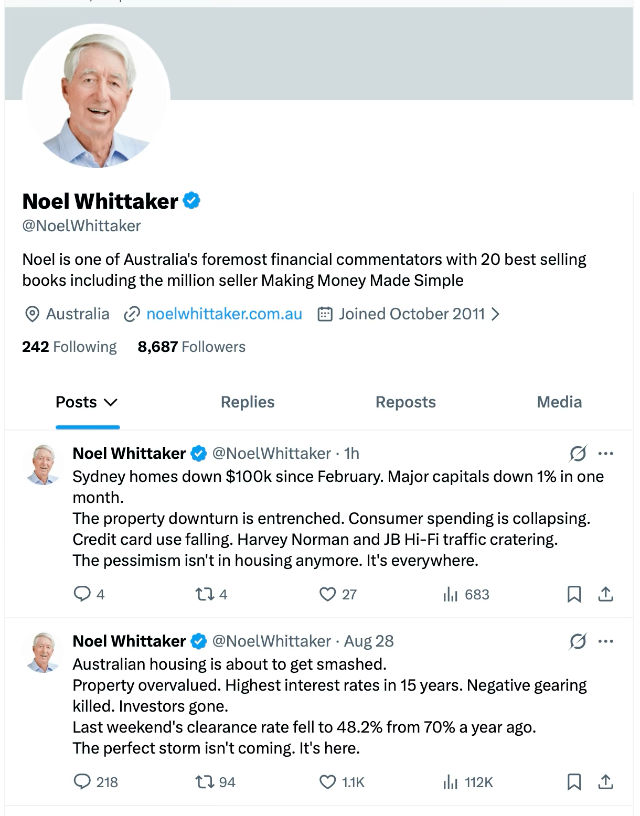
Don’t forget to follow me on X
X is becoming a very powerful medium to keep you up-to-date with information. I’m now posting most days with what I see as the topic of the day. This was the one I posted last Friday – would love for you to join me. There’s no cost.

I hope you have enjoyed the latest edition of Noel News.
Thanks for all your kind comments. Please continue to send feedback through; it’s always appreciated and helps us to improve the newsletter.
And don’t forget you’ll get more regular communications from me if you follow me on X – @NoelWhittaker.
Noel Whittaker