

“Prosperity is not without many fears and distastes;
and adversity is not without comforts and hopes.”
FRANCIS BACON
Welcome to our October newsletter
I chose the Bacon quote above because I think it’s particularly appropriate right now. I’m a glass-half-full person, but there’s no doubt the world is going through a challenging period.
Governments everywhere are struggling under massive debt burdens, and the irony is that there are only a few ways out: cut spending, raise taxes, or somehow generate much stronger economic growth. The first two are politically unpopular, while the third is much easier said than done.
As I’ll explain later, the bond market is pointing to higher interest rates, while many of the headlines right now are about falling property prices. When I talk to agents around the place, they tell me vendors are becoming reluctant to sell because they know they may not get the price they expected.
Even the Bank of Mum and Dad is becoming more cautious. Parents are asking why they should help their children buy a home today if they believe it may be cheaper tomorrow. And that hesitation has ripple effects. A quieter property market means less stamp duty revenue for state governments and less spending on furniture, appliances, renovations and all the other things that go with buying a home.
That’s the challenging part. But Bacon’s point is that adversity also brings opportunity. Markets and circumstances change, and opportunities appear where we least expect them. The important thing is to understand what is happening, keep a sense of perspective and be ready to take advantage of those opportunities when they come.

PODCAST
Making Money Made Simple
with Noel Whittaker
Renowned broadcaster John Deeks and I discuss all the big topics covered in this newsletter in detail each month.
Our Next Event

YAMBA • THURSDAY 22 OCTOBER • 12 NOON–2 PM
I’ll be in Yamba for a special session on retirement living, and I’d love you to join me. We’ll be talking about the big questions that come with making a move in retirement: how retirement village living works, what the contracts really mean, how a move could affect your Age Pension and finances, and what you should consider before making a decision.
ADMISSION IS FREE, AND A LIGHT LUNCH WILL BE SERVED.
Join me for an informative and enjoyable couple of hours.
Places are limited and RSVPs are essential
WHEN
Thursday 22 October
12 noon–2 pm
WHERE
Yamba Golf Club
28 River Street
RSVP
RSVP by Monday 19 October
Aurora 0435 438 456 • apagonis@uniting.org
Interest Rates
At its last meeting, the Reserve Bank raised interest rates once again, and there are strong hints that more increases may be to come. It’s unfortunate that monetary policy – adjusting interest rates – is about the only tool we seem prepared to use to fight inflation. Only around a third of Australians have mortgages, and they are typically working people with families. It seems unfair that they should bear so much of the pain of the Reserve Bank’s efforts to bring inflation under control.
The traditional response to inflation is to reduce demand by raising interest rates. We used to work on the theory that if an economy became too strong, you hit the brakes hard enough to pull everything back. The danger is going too far. The outcome can be a recession, with people losing their jobs and businesses failing. Remember Paul Keating’s famous line: “the recession we had to have.”
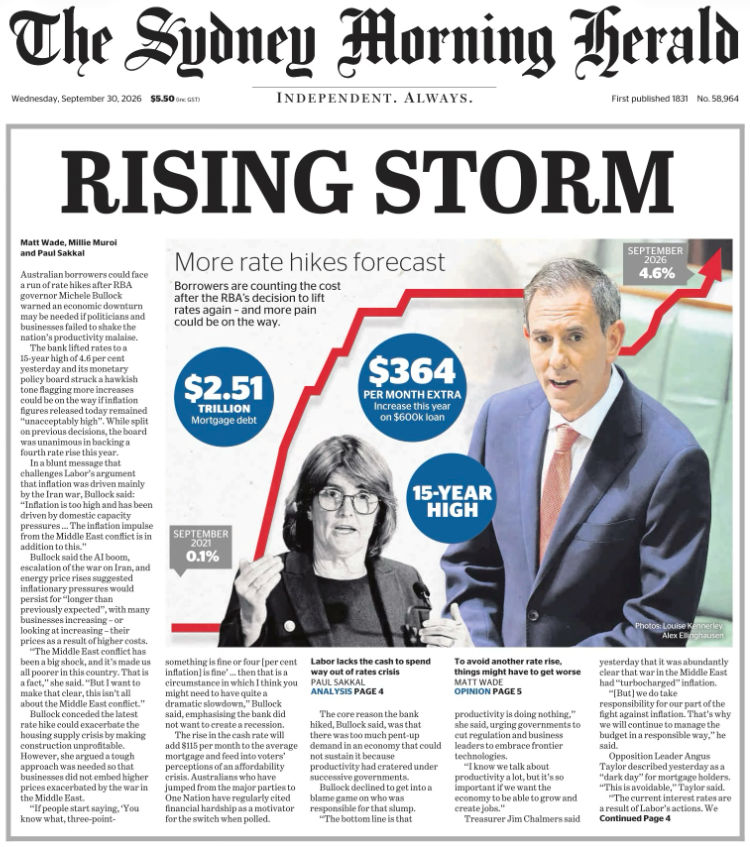
I don’t see a recession anytime soon, but it always pays to be prepared. Make sure your mortgage payments are up to date and that you have sufficient funds available to cover at least three years of planned expenditure. Markets are turbulent right now, and the last thing you want is to be forced to cash in growth assets such as shares or property while they are going through a slump. Having adequate funds in reserve gives you the ability to ride out the bad times and wait for markets to recover.
Reserve Bank Governor Michele Bullock has also stressed that Australia has a serious productivity problem. She’s stating the obvious: we now rank just 16th among OECD countries for labour productivity, while productivity actually fell in the latest year. Commonwealth gross debt is around $1 trillion, and the latest Intergenerational Report tells us the federal budget faces deficits for the next 40 years.
Yet we seem determined to make the productivity problem worse with ever more regulation, compliance and red tape. We’ve already seen what it has done to the building industry and financial planning. Comprehensive financial advice now costs at least $5,000 and comes buried in compliance paperwork few ordinary Australians could possibly be expected to read, let alone understand.
And now we are doing it again with ever-expanding identity checks and anti–money-laundering rules.
Banks Behaving Badly
That issue became very personal for me recently. My wife and I have been customers of St. George Bank for more than 40 years. We both received letters asking us to verify our identity and answer questions including: “What is the origin of your net worth?” and “What is the purpose of the bank account?” If the object is to catch criminals, I doubt the baddies are going to provide their criminal history. And to me, the purpose of a bank account should be bleeding obvious.

We completed the forms and returned them, only to receive identical letters four weeks later. Reluctantly, we did the whole thing again, including a visit to our accountant to have copies of our passports certified. A fortnight later came a third request. I’d had enough and lodged a complaint, pointing out that we had supplied the information twice in the bank’s own reply-paid envelopes without receiving any acknowledgment.
The bank’s response was extraordinary: they froze our bank accounts. I don’t think I have ever been more angry in my life.
When your accounts are frozen, you’re told to ring a 1300 number, so you can spend an eternity listening to, “We’re experiencing an unusually high volume of calls.” It took two hours to get our accounts operating again, and by then I was determined to find out what was going on.
I set up discussions with AUSTRAC, the Australian Banking Association and senior bank executives – channels most customers cannot access. The ABA told me identification requirements were a major source of customer complaints, while one senior banker said much of what was needed to detect criminal activity could be found simply by examining transactions.
A senior bureaucrat told me his 80-year-old mother nearly had a heart attack when asked to identify herself because she thought she had been the victim of identity theft. He also pointed to difficulties in some Indigenous communities, where people may not have the documents the government requires. My doctor told me the same thing had happened to her – this time with ANZ.

AUSTRAC says the questions help banks establish what normal activity should look like for a customer. Knowing who customers are, where their money comes from and how they intend to use financial services provides a benchmark. If subsequent transactions don’t fit the customer’s story, that may raise a red flag.
I can’t argue with the objective. I’m less convinced about the method. A criminal is hardly likely to answer “drug dealing” when asked about the source of their wealth. Surely what actually happens in the account tells the bank far more than a questionnaire ever could.
And think of the productivity cost. Customers spend hours finding documents, getting them certified and returning forms. Banks spend countless hours processing them.
But surely the Nobel Prize for bureaucratic stupidity goes to whoever decided the best way to follow up an unanswered request was to freeze the customer’s bank account. The customer discovers their money is inaccessible, rings the inevitable 1300 number and joins a queue. Eventually a staff member has to investigate, establish the customer’s identity and get the account operating again.
Then there are the hidden costs. A decades-long relationship can be destroyed by freezing someone’s money without so much as a phone call. What about the stress caused to customers? And what about bank staff dealing with distressed customers day in, day out?
Australia has a productivity problem, yet we keep designing systems that consume more of everybody’s time. Every hour a customer spends chasing paperwork, and every hour a bank employee spends sorting out the resulting mess, is an hour that could have been used productively.
Super changes all the time and there are plenty for 2026 – 2027.
Released Sept 2026, this 8th edition has been fully updated with all the new rules, thresholds, tables, pensions, tax and worked examples with the Division 296 chapter completely rewritten.
Essential reading if you want to understand Australia’s superannuation system and put a plan in place to make it work tirelessly in your favour.
Available in print or ebook.
The Bond Market
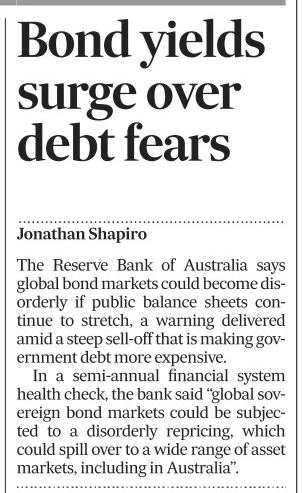
Suddenly the bond market is grabbing headlines. World debt is soaring, tensions in Iran and Ukraine are intensifying, and a market most Australians rarely think about is becoming impossible to ignore.
The numbers are staggering. At around US$160 trillion, the global bond market is the biggest financial market in the world, slightly larger than all the world’s listed sharemarkets combined. More importantly, what happens there affects your mortgage, your superannuation, your shares and property, the Australian dollar and ultimately even your taxes.
A bond is simply an IOU from a government or corporation. It promises investors a capital sum at some future date, together with interest along the way. Take two Australian Government bonds. One pays just 1% and matures in November 2031; the other pays 5% and matures in June 2036.
Take the 2031 bond. It pays just $100 a year on a face value of $10,000. With market rates around 5%, who would pay $10,000 for something yielding just 1%?
Nobody — and that’s the point. Bonds are liquid investments, and their prices rise and fall with the market. When market interest rates rise, the price of an existing bond falls until its return becomes competitive. Today you might pay roughly $8,200 for that $10,000 bond. You still receive the $100 annual interest, but when it matures the government pays you the full $10,000. That $1,800 difference is part of your return.
Compare that with the 2036 bond paying 5%, or $500 a year on $10,000. Because that is close to today’s market rate, its price stays around $10,000.
That’s the golden rule: when interest rates rise, existing bond prices fall; when rates fall, bond prices rise. Don’t confuse the coupon with the return. A bond paying 1% can still give a new buyer a return approaching 5% because its price has fallen.
The big issue now is that investors are demanding more to lend governments money. Inflation remains stubborn and geopolitical uncertainty is high, but the elephant in the room is debt. Governments are spending more than they receive and borrowing the difference. US government debt has passed US$40 trillion, while global public debt is heading towards 100% of world GDP by 2029. Somebody has to fund it, and lenders are saying: fine — but you’ll have to pay us more.

This is where the bond market flexes its muscles. Governments control taxation and spending, while central banks control official short-term interest rates, but neither can completely control the bond market. If investors believe a government is borrowing too much or allowing inflation to get out of control, they can refuse to buy its bonds at existing prices. Prices fall and yields rise until buyers return.
US Treasury Secretary Scott Bessent recently threw down the gauntlet to financial markets. Speaking about US intervention to support the Japanese yen, he declared: “I am the house now … And you can bet against me if you want.”
Bessent, of all people, should understand the danger of that challenge. In 1992 he was part of George Soros’s team when it took on the Bank of England, betting that Britain could not continue defending the pound. The government fought back, even announcing interest rates as high as 15%, but the market won. Britain was forced out of the European Exchange Rate Mechanism on Black Wednesday, and the Soros fund made more than US$1 billion.
Bessent has now changed sides. The trader who helped take on the house is running the US Treasury and declaring that he is the house. But his former boss and mentor Stanley Druckenmiller has a simple warning about governments taking on markets: ultimately, “they always lose”.
Perhaps the best description of the bond market’s power came from James Carville, political adviser to Bill Clinton. He famously said that if reincarnation existed, he wanted to come back as “the bond market. You can intimidate everybody.”
And what does all this mean for us?
The United States matters because US Treasury bonds are the benchmark for much of the world’s debt. When the US 10-year Treasury yield heads towards 5%, investors naturally ask why they should accept substantially less elsewhere.
The Reserve Bank sets Australia’s cash rate, but it does not dictate interest rates for the next 10, 20 or 30 years. Those are determined by financial markets and reflect inflation, economic growth, expectations about future Reserve Bank decisions and what is happening overseas. The bond market can tighten financial conditions without the Reserve Bank doing a thing.
Homeowners should take notice. Variable mortgage rates are heavily influenced by the cash rate, but banks obtain money from many sources, and their wholesale funding costs and fixed-rate loans are influenced by bond and swap markets.

Investors should take notice too. When interest rates were close to zero, investors seeking income were virtually forced into shares, property and other riskier assets. Now shares and property have competition. Why take substantial risk for a 4% income return if you can get around 5% from a high-quality government bond?
There is a sting in the tail. If you already own a bond paying 2% and new bonds offer 5%, nobody will pay full price for yours. Its price must fall until its return becomes competitive. That is why supposedly conservative bond funds can suffer capital losses when interest rates rise. But for retirees and other income investors, the flip side is attractive: new money invested in fixed interest can now earn returns unimaginable just a few years ago.
Australia is also a major borrower. There is close to $1 trillion of Australian Government Securities on issue, and around half of Australian Treasury Bonds are held by overseas investors. We therefore depend heavily on international investors continuing to lend us money. If they demand higher returns, we have to pay them.
The bond market may seem remote from everyday life, but it sets the price of money. It influences what governments and businesses pay to borrow, what banks charge their customers and how investors value almost every other asset.
Perhaps Carville had it right all along: the bond market can intimidate everybody. Right now it is sending a warning — the days of virtually free money are over.
From the mailbox
Question
Under the new capital gains tax rules, some properties may need a market value established as at 30 June 2027 so that gains accruing before and after 1 July 2027 can be calculated. Given the huge number of properties potentially involved and the relatively small number of valuers, should property owners arrange a valuation before 30 June 2027, or will the Tax Office accept a retrospective valuation done later? We are confused because we have heard two different views. Furthermore, do we need a registered valuer?

Answer
A Tax Office spokesman tells me there is no need to rush out and have your property valued before 30 June 2027. In fact, if you intend to rely on a market valuation, you should not obtain one now. A prospective valuation – one prepared before the specified valuation date – will not be acceptable. A retrospective valuation prepared later can be used and, in many cases, may be preferable because the valuer will then have access to a broader range of records and actual comparable sales around the relevant date, allowing a more informed assessment.
There is another important point. The new rules apply to capital gains accruing from 1 July 2027, but tax is generally not payable until the gain is eventually realised, such as when the property is sold. If you choose to use a valuation-based method to work out your tax consequences, you will only need the valuation, as at 30 June 2027, when preparing your tax return in the year of disposal and self-assessing your taxable gain. You may, of course, choose to obtain the valuation earlier.
Importantly, not every affected property will necessarily need a formal valuation. Taxpayers may have a choice between establishing the property’s market value immediately before 1 July 2027 and using an alternative apportionment method the Government is developing. The Tax Office says it will provide further guidance, tools and calculators once the legislation and method are settled.
As for whether you need a registered or professional valuer, the Tax Office says that, for tax purposes, the acceptability of a valuation usually depends on the valuation process and the asset being valued rather than simply on who conducted the valuation. There are exceptions – for example, a professional valuer is required for a market valuation for GST margin scheme purposes. The Tax Office also points out that valuations undertaken by professional valuers are generally more credible than those prepared by somebody who is not a professional valuer.
But engaging a professional does not shift the responsibility. The onus remains on the taxpayer to provide a valuation that is replicable and defensible. The Tax Office says its forthcoming guidance will give more detail on how market values may be determined for different types of CGT assets, the types of professionals taxpayers may wish to engage, and the documents and records that should be kept.
In the meantime, the message is simple: don’t panic and don’t pay for a valuation now. If a market valuation is eventually required, it can be prepared retrospectively for 30 June 2027. And before spending money on a professional valuation, wait for the Tax Office’s detailed guidance on exactly what will be required.
And finally
HOW TO WRITE GOOD

1. Avoid Alliteration. Always.
2. Prepositions are not words to end sentences with.
3. Avoid clichés like the plague. They’re old hat.
4. Comparisons are as bad as clichés.
5. Be more or less specific.
6. Writers should never generalize.
Seven: Be consistent!
8. Don’t be redundant; don’t use more words than necessary; it’s highly superfluous.
9. Who needs rhetorical questions?
10. Exaggeration is a billion times worse than understatement.
Attributed to Hal Conick
Don’t forget to follow me on X
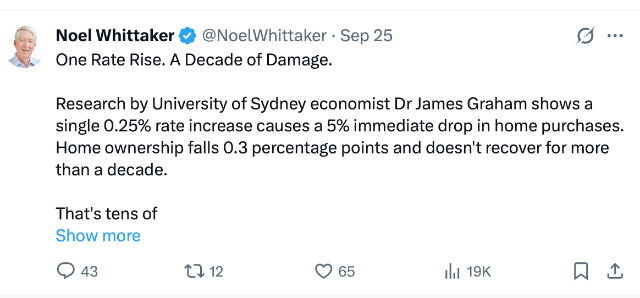
X is becoming a very powerful medium to keep you up-to-date with information. I’m now posting most days with what I see as the topic of the day. This was the one I posted last Friday – would love for you to join me. There’s no cost.

I hope you have enjoyed the latest edition of Noel News.
Thanks for all your kind comments. Please continue to send feedback through; it’s always appreciated and helps us to improve the newsletter.
And don’t forget you’ll get more regular communications from me if you follow me on X – @NoelWhittaker.
Noel Whittaker