

“Prosperity is not without many fears and distastes;
and adversity is not without comforts and hopes.”
FRANCIS BACON
Welcome to our October newsletter
It’s hard to believe another year is rapidly drawing to a close, with Christmas and the New Year just around the corner. Normally, this is a time to look forward with optimism, but I’m finding that increasingly difficult. In last month’s newsletter, I pointed out that the world was going through a particularly challenging period. Well, I hate to be the bearer of bad news, but I think things are getting worse. Interest rates around the world are under renewed upward pressure, which is the last thing Australian mortgage holders need, while the fallout from last May’s federal budget continues to cast a long shadow over our economy. It’s hardly the cheerful end to the year we were hoping for.

The property market is a prime example. The government announced sweeping changes to negative gearing and capital gains tax, designed to discourage investment in established housing and make it easier for first-home buyers to enter the market. Under the new rules, investors buying established properties after budget night will no longer be able to offset rental losses against their wages from July 2027, although existing investments are protected and new homes are exempt. The 50% capital gains tax discount will also be replaced by an inflation adjustment and a minimum 30% tax on gains accruing from July 2027, with special concessions for new housing. These changes reduce the attractions of investing in established property, and it’s hardly surprising that investors are reconsidering their options. If fewer properties change hands, state governments will also feel the pinch through reduced stamp duty collections. It’s a stark reminder of how dependent governments have become on a buoyant property market.
It’s a classic catch-22. The government wants to make housing more affordable by taking some of the heat out of property prices, but there’s that troublesome law of unintended consequences. At the same time, government spending remains under pressure, inflation is proving stubborn and mortgage rates are making life increasingly difficult for buyers. And here’s the real kicker. Every time you turn on the television or open a newspaper, there’s another headline warning that property prices could fall further. If that’s the prevailing sentiment, who in their right mind would rush out and buy a property today when they believe it might be cheaper tomorrow? Lower prices should help first-home buyers, but only if they can afford the repayments and have the confidence to take the plunge. The danger is that in trying to make housing more affordable, the government could end up creating a market in which buyers and investors alike are too nervous to act.
The painful price of four years of RBA rate rises
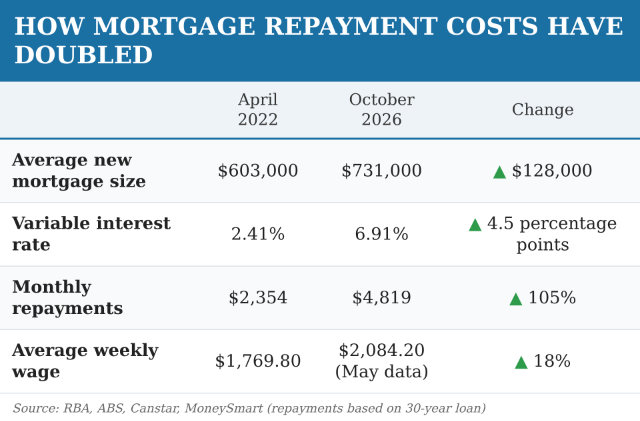
Meanwhile, both National Australia Bank and Westpac have announced plans to shed staff. One of the pressures facing Australian workers is the growing ability of large organisations to move routine work offshore, where labour costs can be a fraction of those in Australia. Call centres are an obvious example, but the trend is spreading well beyond them. Technology has made it easier than ever for companies to employ people in other countries, and the temptation to cut costs is enormous. It’s another challenge for Australian workers, particularly those who believe working from home offers them long-term job security. Never forget, if you can work from home, there’s a fair chance someone else can do your job from the Philippines.

PODCAST
Making Money Made Simple
with Noel Whittaker
Renowned broadcaster John Deeks and I discuss all the big topics covered in this newsletter in detail each month.
Our Next Event
Wed 2 Dec at Bairnsdale Racecourse

The American election
Here’s a thought that might surprise you: one of the best things American politicians can do for the sharemarket is stop making laws and start fighting among themselves. It sounds ridiculous, but history suggests Wall Street actually performs better when neither political party has complete control of Washington. In other words, political gridlock may be just what investors need.
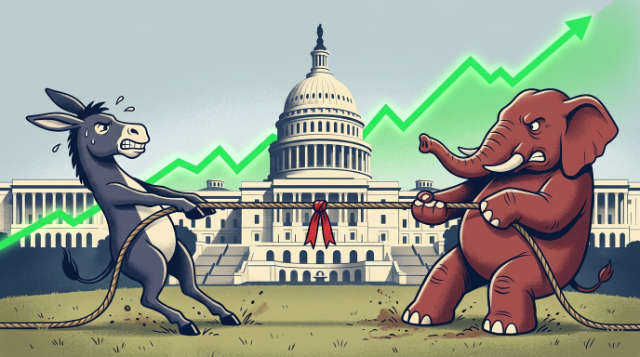
Since 1980, the S&P 500 has delivered an average gain of 15% in the year following elections that left neither party in complete control of Washington. When one party controlled everything, the average gain was a more modest 11.5%. Even more remarkably, divided government was followed by a positive year for shares in 14 out of 15 cases. Go back to the 1880s and the figures are just as interesting. There have been 14 midterm elections that left a Republican president facing a divided government, and in 93% of those cases the sharemarket was higher a year later.
Why should political gridlock be good for investors? My theory is that when politicians can’t agree on anything, they can’t do too much damage either. Businesses thrive on certainty, and the prospect of fewer sudden tax changes, new regulations and grand political experiments gives them more confidence to invest, expand and employ people. That creates the conditions for stronger profits and, ultimately, higher share prices.
Of course, history is no guarantee of what happens next, and there are plenty of other factors driving markets. But there’s a comforting thought here: sometimes the best thing politicians can do for the economy is absolutely nothing.
When government help hurts

“I’m from the government, and I’m here to help.” These are the nine most terrifying words in the English language, according to former US President Ronald Reagan.
And you can see why as Australians grapple with changes to credit card surcharges. The incoming ban was supposed to save consumers $1.56 billion, but businesses such as restaurants and coffee shops are already raising prices to compensate. Taxi companies have joined in, some charging 5% of the fare as a “service charge”. Institutions that can’t easily raise their prices are refusing to accept credit card payment, so if that’s how you budgeted for school fees, council rates or income tax payments, you’ll need to think again. And, of course, the banks couldn’t let the opportunity pass. Annual credit card fees have leapt, reward points have been slashed, and consumers are wondering where their promised savings have gone.
But it needn’t be like this. Here are three simple changes the government could make, at little cost, that could transform the lives of hundreds of thousands of Australians.
ONE

Let’s start with the issue dominating talkback radio since I wrote about it a fortnight ago: banks freezing customer accounts without warning because they haven’t supplied additional identification or other information. It’s a financial cyberattack, but it’s the banks attacking their own customers. Suddenly, people can’t access their money, pay their bills or run their businesses. The consequences can be devastating. The only remedy is to spend hours on the telephone trying to reach a human being, or to find a branch that’s still open and join the queue in person. Imagine a small business owner, already battling rising costs and endless red tape, who suddenly finds his account frozen. He can’t pay staff or suppliers, and must abandon his business for hours to sort out a problem entirely of the bank’s making. That’s productive time lost, income forgone and another blow to a business already struggling to survive.
My inbox has been flooded with horror stories, but one takes the cake. A friend was in discussions with the Commonwealth Bank about whether her family trust’s name should include the word “the”. Was it “XYZ Trust” or “The XYZ Trust”? While those discussions were underway, the bank froze the account. You couldn’t make this stuff up. Who in management decided that minor confusion over the official account name justified denying a customer access to her own money? The sheer arrogance beggars belief.
Electricity companies have special obligations to customers who depend on life-support equipment. Once registered, those customers must receive advance notice of planned power interruptions so they can make alternative arrangements. Yet a bank can suddenly cut off someone’s access to their money, leaving them unable to buy food, pay bills or meet essential expenses. Legislation forces electricity companies to take special precautions before interrupting a customer’s power lifeline; surely a bank should have similar obligations before cutting off financial lifelines. The principle is identical: give people reasonable warning and an opportunity to protect themselves before pulling the plug.
Of course, banks have legal obligations to verify identities and comply with anti-money-laundering laws. Nobody disputes that. But those obligations should not be an excuse for treating customers like criminals. We need legislation requiring banks to exhaust every reasonable avenue of communication – including personal contact where practicable – before freezing an account, unless immediate action is legally required or necessary to prevent fraud. And if an account is frozen, there should be a fast, direct and effective way to resolve the problem, not hours spent begging for someone to answer the telephone on the general number.
This would spare customers enormous distress, save businesses needless disruption and reduce the time bank staff spend cleaning up the mess. It would cost the government virtually nothing. Banks make billions in profits from their customers. Giving those customers access to their own money – unless there’s a compelling legal reason not to – is both core business and basic decency.
TWO

Borrowers are constantly urged to shop around for a better home loan rate, but there’s a catch that keeps buyers without a 20% deposit tied to their bank. It’s lenders mortgage insurance, which can cost more than $20,000.
Suppose you’ve paid $20,000 in mortgage insurance on your ANZ loan and discover CBA is offering a much better rate. You decide to switch. Same borrower, same property, and substantially the same risk. But lenders mortgage insurance isn’t transferable between banks, so you could face another $20,000 premium. That’s money struggling borrowers simply don’t have.
The result? Borrowers become prisoners of their existing lender until they’ve built enough equity to avoid mortgage insurance. And the banks know it. The solution is obvious: require the lending and insurance industries to develop a system that allows borrowers to refinance without paying the full insurance premium all over again. There are only a handful of insurers; surely it can’t be beyond them to work out a practical arrangement.
Borrowers could then shop around without being penalised. More competition, lower repayments and not a cent of government expenditure. Problem solved.
THREE

Some of Australia’s most vulnerable people are older renters, particularly single women who have escaped domestic violence or never managed to buy a home. As rents soar and Centrelink assistance falls behind, returning to work can leave them facing a bewildering combination of pension reductions and income tax.
Take Margaret, 67, who has virtually no assets and pays $400 a week in rent. Rent assistance of $111.90 a week reduces that cost to $288.10. Her full age pension of $32,180 brings her annual income, including rent assistance, to $37,999. Suppose she takes a job paying $45,000, or about $1,731 a fortnight. Once assessable income exceeds $226 a fortnight, her pension falls by 50 cents in the dollar. The Work Bonus exempts $7,800 annually, with a possible additional $4,000 credit. Even so, Centrelink assesses $33,200 of her wages, reducing her pension by around $530 a fortnight to $18,518 a year.
Then comes the taxman. Her wages and remaining pension are both relevant to her tax position, and the combined effect of tax and pension reductions can take a substantial bite out of the extra money she earns. What an extraordinary way to treat someone trying to improve her circumstances.
Contrast this with the Wilsons, who own a $3 million home and have $800,000 in super and $50,000 in lifestyle assets. They receive a part pension of $21,138, enjoy concession cards and withdraw $80,000 tax-free from super. Because Centrelink generally assesses account-based pensions under the deeming rules rather than counting the withdrawals as income, their position is very different from Margaret’s.
It’s welfare turned upside down. Margaret, with virtually nothing, faces substantial reductions in her pension when she works, while a couple with considerable wealth can draw tax-free income from superannuation without those withdrawals directly reducing their pension.
The government should urgently ease the pension income test for older renters, allowing them to earn substantially more before their pension is reduced. These are people who want to work, need the money and have something to contribute. Instead of punishing them, we should be encouraging them. Surely that’s what good government is supposed to do.
The response from Canberra
The response from Canberra was revealing. Both One Nation and the Greens said they would support these ideas, while Shadow Treasurer Tim Wilson said: “While we have not announced a formal policy, we support greater flexibility in lenders mortgage insurance, allowing pensioners to work without penalty, as we advocated at the last election, and preventing banks from freezing accounts unnecessarily because of needless regulation. We will consider these issues as part of our deregulation agenda.”
Labor was less enthusiastic. It failed to answer the first two questions and offered a generic response on pensions that suggested it hadn’t even understood the problem. On that response, low-income single pensioners shouldn’t hold their breath waiting for relief. Three simple reforms, virtually no cost to taxpayers, and enormous potential benefits. Surely that’s not too much to ask of our politicians.
The hidden tax: Shrinkflation
Everywhere I go, people are complaining about the soaring cost of living. I must confess I’ve been somewhat sheltered from it because Geraldine does most of our household shopping. But I got a rude awakening the other day when I went to buy a box of my favourite chocolates, Lindt Lindor Dark Assorted. I used to pay around $20 a box, but suddenly the price had jumped to $30. That was bad enough, but then I discovered something even more outrageous. The contents had shrunk from 327 grams to just 268 grams. That’s 18% less chocolate and a 50% increase in the price I was accustomed to paying. Welcome to the wonderful world of shrinkflation, where you pay more, get less, and the manufacturers hope you won’t notice. And here’s the sneaky part: the box is still the same size. There’s simply less chocolate inside it. The only thing that hasn’t shrunk is the bill.

But the story gets even more interesting. I asked ChatGPT to hunt around for a bargain on my favourite chocolates, and it came back with an urgent message: Woolworths had them at half price for the first three days of November. At $15 instead of $30, I wasn’t going to miss that opportunity. I promptly headed down to Woolworths and bought 10 boxes. But as I walked out with my haul, I couldn’t help wondering about the economics of the chocolate business. If a retailer can slash the price of a box from $30 to $15, just how much profit is built into the original price? Of course, retailers sometimes sell products at little or no profit to attract customers, but it does make you wonder. Perhaps the biggest mystery isn’t why the chocolates have shrunk, but how anyone arrives at the price in the first place.
Beating the 1300 numbers

A reader has sent me a couple of useful tips for getting past those infuriating telephone menus and actually speaking to a human being. The first is to try www.gethuman.com, a free website where people share tricks for getting through to a real person at thousands of companies. Sometimes it’s as simple as pressing a particular number or saying the right word.
The second tip is to avoid the company’s main 1300 or 1800 number and search online for the direct number of its head office or a local branch. You might get straight through to a receptionist instead of spending half your morning arguing with a robot.
Neither method is guaranteed, but they’re certainly worth a try.
The latest scam
It seems the scams never stop coming. If you’ve got a company, you’ve probably received an official-looking letter in the mail talking about your annual review fee. A copy of the letter I received is below:
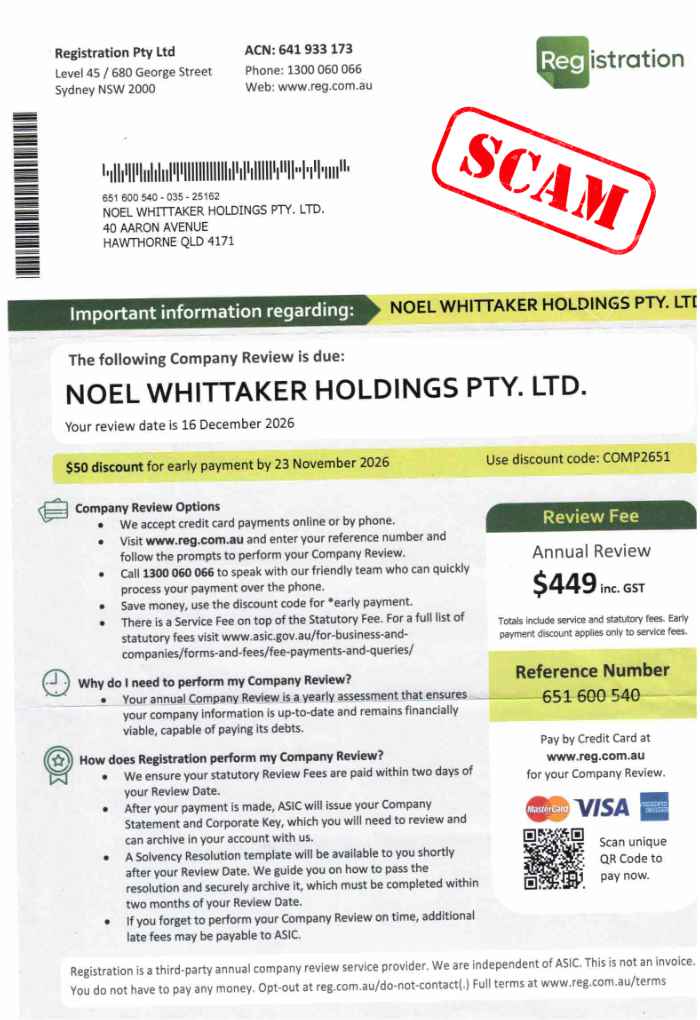
This is so much like the ASIC annual review fee, which we all pay, that it’s easy, in a busy moment, to just pay it. The fine print is an offer for them to prepare your annual review for you, which is normally done by your accountant. Beware.
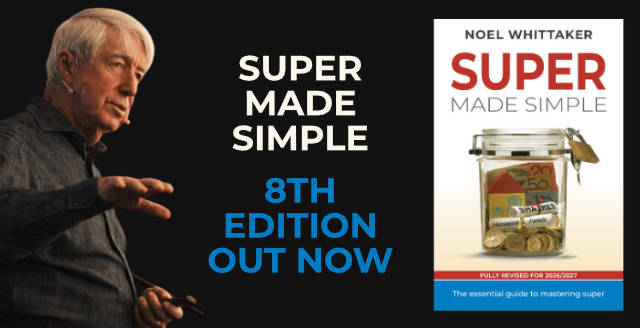
The May 2026 Budget has changed the investment game – and superannuation has emerged as the big winner.
With sweeping changes to capital gains tax and negative gearing, super is now arguably the most attractive place to build wealth outside your own home. But there’s a catch. The rules are changing fast, and unless you understand them, you could miss out on valuable opportunities or make costly mistakes.
That’s why I’ve completely revised my bestselling Super Made Simple for 2026–27. The new 8th edition explains the Budget changes in plain English and, more importantly, shows you how to make the new rules work for you. You’ll discover ways to maximise your contributions, minimise tax, boost your retirement savings and make smarter decisions about when and how to draw on your super. It covers the end of many capital gains tax strategies from 30 June 2027, the ban on borrowing by self-managed funds to buy property, the rewritten $3 million super tax, and all the latest caps and thresholds. Whether you’re still building your nest egg or already retired, the aim is simple: help you keep more of your money, avoid expensive traps and enjoy a more comfortable retirement. One good decision could save you many times the cost of the book.
And here’s a special offer for my loyal readers. If you’ve previously purchased an ebook edition from noelwhittakerebooks.com.au, you can upgrade to the brand-new 8th edition for just $3.95. Simply use the code SUPER8UPGRADE at checkout or click the button below, making sure you use the same email address as your original purchase. But don’t leave it too long – this special launch offer ends on 15 November.
If you’re new to Super Made Simple, the ebook is just $16.95, with both PDF and EPUB formats included. For less than the cost of a couple of coffees, you’ll have a practical guide to making better super decisions and getting more out of your retirement savings.
Click here to claim your previous reader discount:
Or get your physical copy here:
And finally
A teenage boy had just passed his driving test and inquired of his father as to when they could discuss his use of the car.

His father said he’d make a deal with his son, “You bring your grades up from a C to a B average, study your Bible a little and get your haircut. Then we’ll talk about the car.”
The boy thought about that for a moment, decided he’d settle for the offer and they agreed on it.
After about six weeks his father said, “Son, you’ve brought your grades up and I’ve observed that you have been studying your Bible, but I’m disappointed you haven’t had your hair cut.”
The boy said, “You know Dad, I’ve been thinking about that, and I’ve noticed in my studies of the Bible that Samson had long hair, John the Baptist had long hair, Moses had long hair, and there’s even strong evidence that Jesus had long hair.”
Love the Dad’s reply!
“Did you also notice that they all walked everywhere they went?”
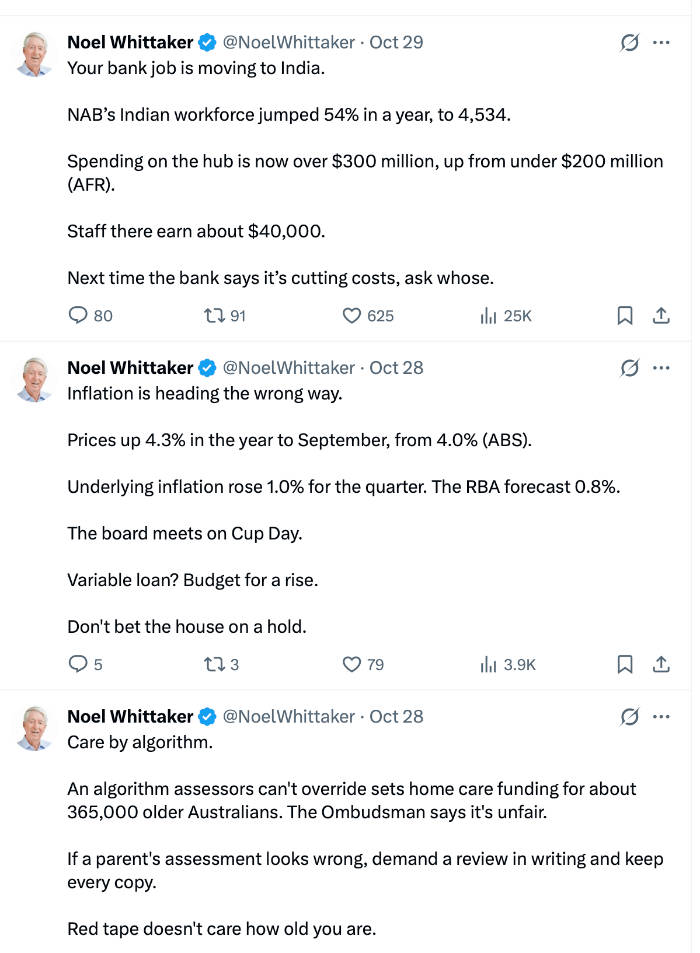
Don’t forget to follow me on X
X is becoming a very powerful medium to keep you up to date with information. I’m now posting most days with what I see as the topic of the day. I would love for you to join me – there’s no cost.
Here are a few of my recent posts:

I hope you have enjoyed the latest edition of Noel News.
Thanks for all your kind comments. Please continue to send feedback through; it’s always appreciated and helps us to improve the newsletter.
And don’t forget you’ll get more regular communications from me if you follow me on X – @NoelWhittaker.
Noel Whittaker