

“Oh, what a tangled web we weave,
when first we practise to deceive”
SIR WALTER SCOTT
Welcome to a new financial year
It’s been one of the most extraordinary financial years I can remember. Twelve months ago, most economists thought interest rates had peaked. Instead, inflation proved much more stubborn than expected, the Reserve Bank raised rates three more times, and borrowers found themselves under renewed pressure.
Then came the Iran war. It reminded us just how quickly geopolitical events can affect our lives. Oil prices surged, inflation fears returned overnight and markets became extremely volatile. Fortunately, the ceasefire saw oil prices fall back, but it was another reminder that unexpected events can change the investment landscape in a matter of days.
Domestically, the biggest story was undoubtedly the Federal Budget. Whatever your political views, it represented one of the biggest changes to Australia’s taxation system in decades. The changes to capital gains tax, negative gearing and family trusts will have consequences for investors for many years to come.
The housing market has also changed direction. After years of relentless growth, higher interest rates, weaker affordability and the Budget changes have taken much of the heat out of property. We’re now seeing prices soften in some cities and auction clearance rates ease. That’s not a crash; it’s simply a market returning to something closer to normal.
Yet despite all the doom and gloom, sharemarkets have once again demonstrated why long-term investors should never panic. There were sharp falls during the Iran conflict, but markets recovered as uncertainty eased. Investors who stayed the course have once again been rewarded.
Of all those developments, however, the Federal Budget will almost certainly have the longest-lasting impact. Looking back to this time last year, I could never have imagined that any government would burden Australians with what I believe is such an unfair, discriminatory and unnecessary tax reform. Criticism continues to mount. Hardly a day goes by without someone uncovering another flaw buried in the legislation. Worse still, much of it is so vaguely drafted that even tax experts are waiting for further details before giving advice.
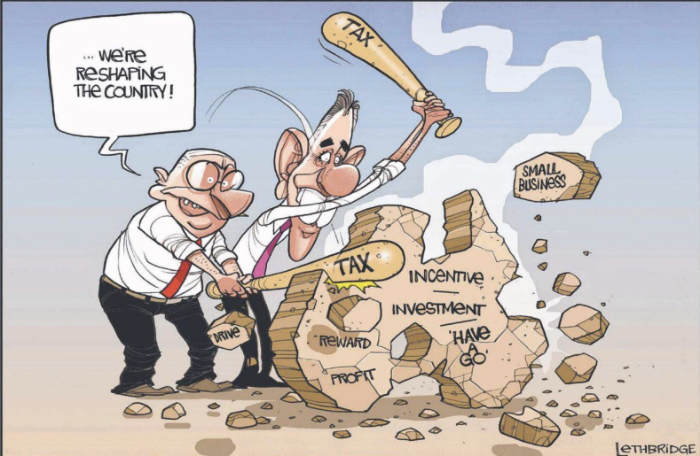
Image by Brett Lethbridge
The attack on negative gearing has already driven many investors from the market, leaving first-home buyers competing for a shrinking pool of properties. The predictable result is tighter rental markets and higher rents. And what possible connection is there between housing affordability and higher taxes on small business, family trusts, testamentary trusts and capital gains? These changes look far more like a revenue grab than housing policy.

PODCAST
Making Money Made Simple
with Noel Whittaker
Renowned broadcaster John Deeks and I discuss all the big topics covered in this newsletter in detail each month.
Noel’s next event
July 30 in Brisbane

If you are thinking about downsizing, retirement living or simply making the most of the next stage of your life, I’d love to see you at the GemLife Over-50s Downsizing Forum.
I’ll be speaking alongside respected aged care expert Rachel Lane and accredited practising dietitian Carly Barlow.
We will be covering the financial issues affecting retirees, including:
- superannuation
- investing
- estate planning and
- the traps to avoid when making major retirement decisions.
Rachel and Carly are both outstanding presenters, so I know you’ll enjoy the morning. GemLife even puts on a terrific morning tea and lunch.
It promises to be an informative and enjoyable event, with plenty of practical information for anyone considering their next move.
WHEN
30 July 2026
Registration from 9:30am for 10:00am start
Concluding at 2:00pm
WHERE
Hotel Grand Chancellor Brisbane
23 Leichhardt Street, Spring Hill
COST
Free
REGISTRATION
To register, simply click on the link below. But don’t leave it too long—these events usually sell out very quickly.
Labor’s four goals
The broader pattern is equally troubling. Labor took four key tax policies to the 2019 election – changes to capital gains tax, negative gearing, family trusts and franking credits – and voters overwhelmingly rejected them. This time the measures have been introduced early in the parliamentary term, well before voters have another opportunity to pass judgement. The recent surge in support for One Nation may suggest many Australians are already uncomfortable with this new direction.
Treasurer Chalmers claims the extra revenue will fund an automatic $1,000 tax deduction for ordinary Australians. Get real, Jim. A $1,000 deduction is worth only about $300 to someone on average earnings, while the $250 Working Australians Tax Offset is of no benefit to people with no taxable income. Together they are worth barely $11 a week to the average worker, yet the major tax measures are expected to raise about $77 billion. If correct, that would represent the biggest tax grab in Australian history. Meanwhile, there is barely a mention of single pensioners who rent and are heavily penalised if they try to supplement their income through part-time work.
Treasury Secretary Jenny Wilkinson was refreshingly candid when she admitted, “Well, we need the money.” Housing Minister Tanya Plibersek also acknowledged that house prices would continue to rise, just “not as much and as fast”. Those two comments tell you far more about the real purpose of this Budget than months of political spin.
The government’s comparisons are equally misleading. It claims replacing the capital gains tax discount with indexation simply returns Australia to the Paul Keating system introduced in 1985. What it doesn’t mention is averaging, which prevented one-off gains from pushing taxpayers into higher tax brackets. If you earn $125,000 and make a $50,000 capital gain, averaging under the Keating system would tax that gain at about 30 per cent. Under the proposed model, most of it would be taxed at 37 per cent. That is not a return to the Keating system. It is a selective version that keeps the revenue-raising features while discarding the taxpayer protections.
Last Tuesday, the national minimum wage was increased by 6 per cent, rising from $948 a week to $1,004.90 a week, or $26.44 an hour. Workers will certainly welcome the increase, but the headlines missed an important point. The increase amounts to about $57 a week. However, around $8 of that disappears in income tax, leaving the employee with about $49 a week extra in take-home pay. Meanwhile, the employer has to fund not only the wage increase but also compulsory superannuation and other on-costs. By the time these are added up, the increase can cost the employer about $65 a week.

Image by Johannes Leak
The government has even invented a new term: the “minimum tax gap”. This is the amount of extra tax payable if the tax generated by your capital gain falls short of 30 per cent of the gain. Calculating it requires a seven-step process to determine your minimum taxable capital gain, followed by another seven-step process to calculate the minimum tax gap. Fourteen separate steps before you even know how much tax you owe. You couldn’t make this stuff up.
Capital Gains Tax
Let’s turn to the issue readers ask me about most – capital gains tax. Under the present system, you subtract your acquisition costs from the sale proceeds to calculate the gain. If you have owned the asset for more than 12 months, you receive a 50 per cent discount and the balance is added to your taxable income. With the top marginal tax rate, including the Medicare levy, at 47 per cent, the maximum effective rate of CGT is 23.5 per cent.
The practical effect of the government’s proposal is to lift the effective rate to a minimum of 32 per cent, including the Medicare levy. If that were really the objective, it could simply have reduced the CGT discount to 40 per cent, lifting the maximum effective rate to 28.2 per cent without creating this extraordinary complexity.
Suppose Jack buys $100,000 worth of shares in July 2024 and sells them for $150,000 in June 2027. His capital gain is $50,000. After the 50 per cent discount, his taxable gain is $25,000. Because he has little other income, he may pay little or no tax.
Now assume he buys the same parcel of shares in July 2027 and sells them three years later for $150,000. If indexation lifts his cost base to $110,000, his gain is $40,000. Under the proposed rules that gain is subject to the 32 per cent minimum tax, producing a tax bill of $12,800.
The anomaly becomes even more striking if Jack is retired. If he receives even a part age pension, he may pay little or no tax because pensioners are exempt from the new regime. If he is a self-funded retiree with exactly the same income and assets, he could face a tax bill running into thousands of dollars. The only difference is whether Centrelink sends him a cheque.
That is where the real unfairness lies. Many self-funded retirees have taxable incomes below $45,000 a year, placing them in the 16 per cent tax bracket. Yet under these proposals they could pay tax on capital gains at an effective rate of 32 per cent – double the rate applying to the rest of their income. These are not people exploiting loopholes. They are Australians who worked hard, saved consistently and deliberately chose to fund their own retirement rather than rely on the age pension.
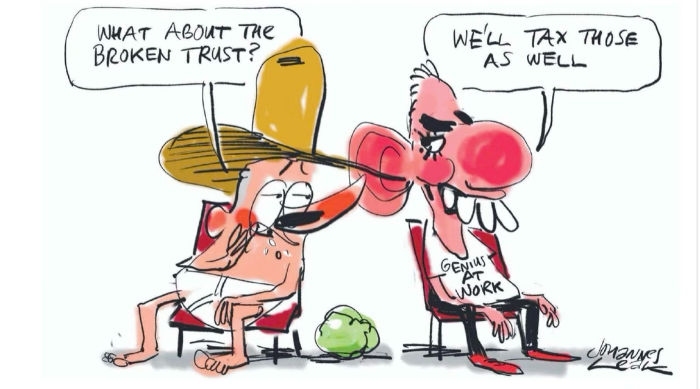
Image by Johannes Leak
The government will no doubt argue that much of this could be avoided by holding investments inside super. But younger Australians cannot afford to lock away all their savings for decades, while many older Australians accumulated investments outside super when the rules were very different. Those over 75 generally cannot make further contributions. For many people, moving assets into super simply is not an option.
Not once has the government acknowledged the enormous cost of complying with these changes. CPA Australia estimates the one-off cost of valuing assets before the new rules commence at between $675 million and $825 million, with ongoing compliance costs of up to $542 million a year. Those are staggering figures, particularly when Treasury estimated compliance costs at just $88 million.
Morgan Housel reminds us in Same as Ever that government policies often produce consequences very different from those intended. Judging by the growing list of anomalies already emerging from this legislation, that lesson is already playing out. The legislation may now be law, but the real test begins when accountants, financial advisers and ordinary Australians start living with it. I suspect many more unpleasant surprises are still to come.
Age, pension, and deeming rate changes

The thresholds for deeming and the age pension changed on 1 July 2026. Calculators on my website are all up to date. There are also pension rate charts up to date under Resources – Free Downloads.
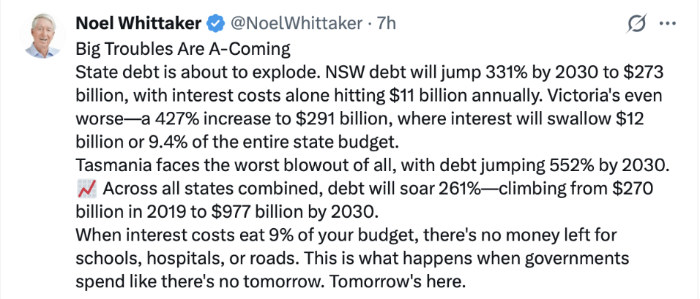
Don’t forget to follow me on X
X is becoming a very powerful medium to keep you up-to-date with information. I’m now posting most days with what I see as the topic of the day. This was the one I posted last Monday – would love for you to join me. There’s no cost.
Your questions answered
This will be a longer newsletter than usual because my inbox has been snowed under with questions from readers. I’m repeating the most important ones here.

Image by vectorjuice on Magnific
Question
I am interested in testamentary trusts and understand that, under the proposed changes, income distributed from a discretionary testamentary trust will be subject to a minimum tax rate of 30%, regardless of the beneficiary’s personal tax rate.
What is unclear to me is how income retained within the trust will be treated. My understanding is that, under the current rules, undistributed trust income is generally taxed at the top marginal rate plus the Medicare levy. Will retained income in a testamentary trust continue to be taxed this way under the proposed changes, or are different rules expected to apply?
Answer
The short answer is yes. Income retained in a trust is generally taxed at the top marginal rate, currently 47% including the Medicare levy. That applies to both family trusts and testamentary trusts, the latter being trusts created under a will. Estate planning solicitor Rachael Rofe, who has met with Treasury on this issue, says the proposed 30% minimum tax applies only to income distributed to beneficiaries, not income retained in the trust. Retained income would continue to be taxed at 47%. If the proposed changes proceed and income is distributed to an individual beneficiary, the trustee would pay tax at 30% and the beneficiary would receive a credit for the tax already paid. If their personal tax rate is higher than 30%, they would pay the difference. If it is lower, there would be no refund.
That is the curious part. Although the measure has been described as targeting wealthy Australians, the additional tax burden falls mainly on low-income earners whose marginal tax rate is below 30%. Company beneficiaries are potentially worse off again, as they would receive no credit for the 30% tax already paid by the trustee. It’s early days yet, as the legislation has not yet been released. Regardless of any proposed tax changes, testamentary trusts remain an important estate planning tool for protecting inheritances from relationship breakdown, bankruptcy and creditors.
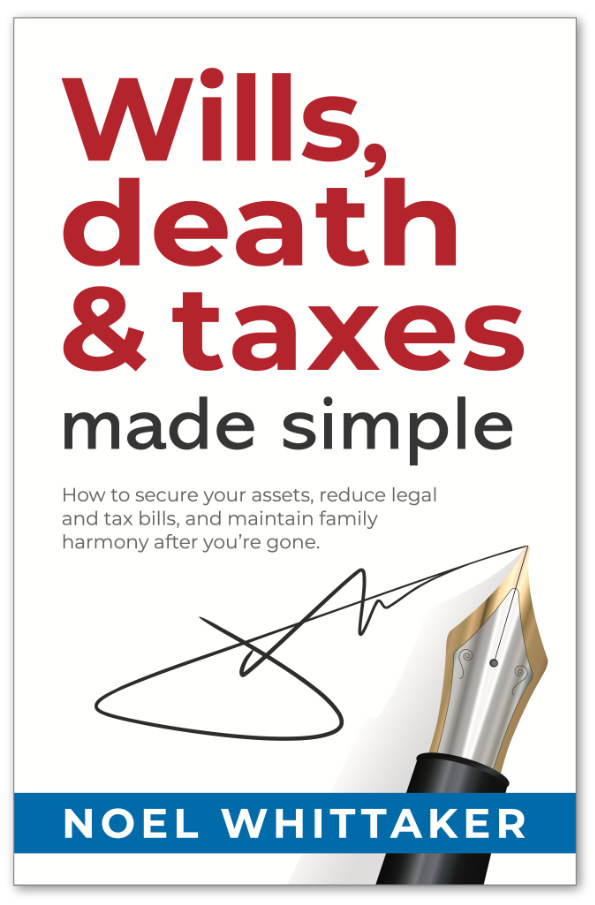
Want to understand estate planning without the legal jargon?
My book Wills, Death & Taxes Made Simple explains wills, testamentary trusts, powers of attorney, superannuation death benefits and estate planning strategies in plain English. If you want to protect your family and minimise unnecessary tax and disputes, it’s a practical guide you’ll refer to again and again.

Image by pch.vector on Magnific
Question
You have advised readers who intend to keep assets beyond 30 June 2027 to obtain a professional valuation around that date. I’ve already entered a reminder in my Google Calendar, but I have two questions.
First, what does the ATO regard as a professional valuation? Would a detailed valuation from a real estate agent be acceptable, or would I need to engage a licensed valuer?
Second, how close to 30 June 2027 should the valuation be obtained? Is there an acceptable timeframe before or after that date?
Answer
This is an area where the Tax Office largely relies on self-assessment, so you should ultimately be guided by your accountant. My understanding is that, for most residential properties, a detailed written appraisal from an experienced real estate agent should be sufficient, provided it is well documented and capable of being substantiated if ever questioned by the ATO.
The valuation should reflect the property’s market value as at 30 June 2027. In practice, there is no need to rush out and obtain it on that exact day. Provided the valuation is prepared shortly after 30 June and clearly states the market value at that date, it should generally achieve the objective.
One additional point: keep copies of the valuation, supporting sales evidence and any correspondence. Records have a habit of disappearing over time, and good documentation could prove invaluable years later if the property is eventually sold and the ATO asks how the 30 June 2027 value was determined. Having said that, don’t panic. Registered valuers can provide historical valuations.

Image by pch.vector on Magnific
Question
I bought a unit off the plan about five years ago and moved into it when construction was completed in 2023. It has been my principal place of residence ever since, but I am now considering moving out and renting it as an investment property. I still owe about $600,000 on the mortgage. How would the proposed Budget changes to capital gains tax affect me if I convert the unit to an investment property? Would the outcome be different if I move out and start renting it before 1 July 2027 rather than after that date? What issues should I be considering before making this decision?
Answer
The negative gearing restrictions announced in the Budget apply only to properties purchased after Budget night, 12 May 2026. As you acquired this property before that date, those rules should not affect you. When the unit becomes a rental property, you should continue to be able to claim all deductible expenses, including interest on the mortgage, against your taxable income.
Because the property has been your principal place of residence since you acquired it, you may also be able to take advantage of the six-year absence rule. This allows you to move out, rent the property, and still treat it as your principal place of residence for capital gains tax purposes for up to six years, provided you do not nominate another property as your principal residence during that period.
That gives you a valuable opportunity. For the next six years, you could own an asset that is not only eligible for negative gearing benefits but may also be sold free of capital gains tax. In effect, you would have an investment property that continues to enjoy principal residence CGT treatment, provided the relevant conditions are met.

Image by freepik on Magnific
Question
My wife and I own shares in several ASX-listed companies and would like to keep them for the long term for both capital growth and dividend income, which helps supplement our Age Pension.
Like many Australians, I am confused about the proposed capital gains tax changes. If we sell before the new rules begin, could the capital gain create a large tax bill? If we hold the shares and sell them later, how will the gains be taxed?
Answer
Any shares you sell before 30 June 2027 will remain under the current capital gains tax rules, including the 50% discount for assets held longer than 12 months. Shares sold after that date will be subject to a much more complicated system. In effect, the capital gain will be split into two parts. The gain that accrued up to 30 June 2027 will continue to receive the existing treatment, while the gain after that date will be calculated using an indexed cost base and may be subject to the new 30% minimum tax. However, if you receive any amount of Age Pension in the financial year in which the shares are sold, you will be exempt from the minimum tax.
Depending on how long you have owned the shares, the additional tax may not be significant. The bigger issue is likely to be the extra record-keeping and accounting costs, because every parcel of shares will require separate calculations.
Self-funded retirees should discuss their options with their accountant well before 30 June 2027. For some, it may make sense to realise capital gains before that date and then reinvest in ETFs, where the ongoing record keeping is generally much simpler. The proposed rules are particularly harsh on self-funded retirees, but despite widespread criticism, the government has shown no sign of changing course.

Image by vectorjuice on Magnific
Question
The government has now confirmed its proposed 30 per cent trust tax will not apply to testamentary trusts. How are these trusts taxed compared with an ordinary discretionary family trust set up during your lifetime?
Answer
This is good news for many families because it ends months of uncertainty. The key is to understand the difference between the two types of trust. A family trust is established during your lifetime and is still scheduled to face the new 30 per cent minimum tax on trust income from 2028.
A testamentary trust, on the other hand, is created under your will and comes into existence only after you die. The government has confirmed these trusts will not be caught by the new tax, provided they form a genuine part of your estate planning. That does not mean the income is tax-free. The normal tax rules continue to apply, with income generally taxed to the beneficiary who receives it, and that is where a testamentary trust can be especially valuable.
If an ordinary family trust distributes income to a child under 18, penalty tax rates apply and quickly reach the top marginal rate. A testamentary trust is different. Income derived from estate assets can be taxed as though the child were an adult, giving them the benefit of the full tax-free threshold. In practical terms, each child with no other income can receive about $22,000 a year tax-free. That money can help pay for school fees, clothing and everyday living costs. For a family with three young children, that is around $66,000 a year flowing to the next generation.
This is not a loophole but a deliberate concession designed to help people provide for their family after they are gone. There can also be a difference where income is retained in the trust instead of being distributed. Many family trusts pay tax on retained income at the top marginal rate, whereas in some circumstances a testamentary trust is taxed at ordinary individual marginal rates instead.
The testamentary trust concession applies only to assets that came from the estate. You cannot add outside assets later and expect the same treatment. The government is still finalising exactly what qualifies as genuine, but the exemption is expected to apply to trusts benefiting individuals and charities rather than companies or other trusts. Once the legislation is finalised, it is worth checking that your will still qualifies. As estate planning solicitor Rachael Rofe says, the decision gives families certainty to keep using a tried and tested way of looking after the people they leave behind. If your will contains a testamentary trust, or you are considering one, it is well worth discussing it with an experienced estate planning lawyer.

Image by vectorjuice on Magnific
Question
My wife and I have a discretionary family trust whose only income is fully franked dividends from Australian shares. The trust distributes that income equally between us, and we include both the dividends and the franking credits in our personal tax returns.
The Federal Budget proposes a flat 30% tax on discretionary trust income, subject to the legislation passing Parliament. If these changes become law, how will fully franked dividends be treated? Will the franking credits first offset the trust’s 30% tax, or will the distributions we receive still carry franking credits that we can claim in our own tax returns?
Answer
Mark Molesworth, tax partner at BDO, says that at present we only have the budget announcement to work from, so you should review your situation once the detailed legislation becomes available.
Based on the announcements, it appears that the franking credits attached to dividends received by the trust will be used to help pay the trust’s minimum 30% tax on its income. When the trust distributes income to you, that distribution will carry non-refundable credits representing the tax already paid by the trust. In other words, you and your wife will probably still receive credits, but they will no longer be refundable franking credits. Instead, they will be non-refundable trustee tax credits.
This may not have a major impact on you because you say you have other income in your personal names on which you pay tax, and the non-refundable credits can be used to offset that liability. However, if you currently receive refunds of excess franking credits through the trust, those refunds may cease from the 2028–29 financial year when the new system is due to commence.
Once the proposed legislation is released, we will be in a much better position to assess what changes, if any, may be required to taxpayers’ affairs.

Image by vectorjuice on Magnific
Question
How will the proposed Capital Gains Tax changes announced in the Budget affect my investment property when I sell it?
I bought the property on 16 September 1981, before Capital Gains Tax was introduced on 20 September 1985. If I sell it before 30 June 2027, will I have to pay any tax on the capital gain?
Answer
As it is a pre-CGT asset, it will be tax-free if you sell it before 30 June 2027. if you keep it after that date, its cost base will become its valuation on 30 June 2027.

Image by vectorjuice on Magnific
Question
My spouse and I are self-funded retirees in our mid-60s. We own our home and a modest 1970s villa unit that we bought outright five years ago for $325,000. We have since renovated it, and before the Budget believed it was worth about $425,000, although it now appears many investors are selling.
The unit is rented to an excellent tenant for $430 a week, who has just signed a further 12-month lease. Our income comes from our super pensions, the rent and interest on bank deposits. Since retiring six years ago, we have paid no income tax because our taxable income has remained below the tax-free threshold.
My husband is reluctant to sell because the unit could provide a useful stopgap home if we sell our house before moving into a retirement village. We have seen too many people commit to a retirement village before selling their home and end up under unnecessary financial stress.
Under the proposed capital gains tax changes, if we eventually sell the unit after 30 June 2027, would we still be able to use our individual tax-free thresholds to offset the capital gain, or would the proposed 30% minimum tax apply regardless of our low taxable income?
Answer
If you sign a contract before 30 June 2027, the entire capital gain will be taxed under the existing rules. If the contract is signed after that date, the gain will effectively be split into two periods.
The portion that accrued up to 30 June 2027 will retain the existing treatment, while the gain after that date will be subject to the proposed new rules, including the 30% minimum tax on this portion even if it is within your tax-free threshold.
Given the relatively modest value of the property and your view that it has limited long-term growth potential, I would be inclined to bite the bullet and sell before 30 June 2027. If you later decide to move into a retirement village, you can generally sign a contract that is conditional on the sale of your home. Most retirement villages are happy to accommodate that arrangement.

Thinking about retirement?
If you’re weighing up downsizing, retirement villages, Age Pension, investing and making your money last, my latest Retirement Made Simple brings all of these topics together in one practical guide, updated for the latest rules and written in plain English.

Image by vectorjuice on Magnific
Question
I understand that SMSFs may be able to reset the cost base of their assets for the purposes of the proposed Division 296 tax.
Does the ATO require any form to be lodged this financial year to make that election?
Also, can individual investors holding shares outside super similarly reset their capital gains tax position without actually selling the assets?
Answer
Meg Heffron confirms that no action is required this financial year. The ATO does not need to be notified of an SMSF’s decision until the due date of the 2026/27 tax return. At this stage, the ATO has not advised whether trustees will need to complete a specific form, keep documentation on file, or simply make an election as part of the annual return process.
It is also important to understand that this relief applies only to eligible SMSFs and small APRA funds. Individual investors cannot reset the cost base of shares or other investments without selling them. Outside super, the normal capital gains tax rules continue to apply, and a cost base reset generally occurs only when an asset is disposed of and reacquired.
One other point worth noting is that an SMSF that elects to use the relief must reset the cost base of all eligible assets, including those currently showing a capital loss. This differs from the 2017 cost base reset, when funds were able to choose which assets to reset and which to leave untouched.
And finally

Why does eating a clock take so long?
Because it is really time consuming, especially if you go for seconds.
Why did my bald friend keep an old comb?
Because he just can’t part with it.
Why was the invention of the shovel considered so important?
Because it was a groundbreaking discovery. But the invention of the broom was the one that truly swept the nation.
Why couldn’t I finish my carpentry pun?
Because I tried to come up with one that woodwork. I think I nailed it, but nobody saw it.
Why is a book about anti-gravity impossible to put down?
Because that’s literally the point. It’s impossible to put down!
Why didn’t I think orthopedic shoes would help?
Because I had my doubts. But I stand corrected.
Why can’t a melon get married?
Because it cantaloupe.
Why is apple pie so expensive in the Caribbean?
Because a slice of apple pie in Jamaica is $2.00 and $2.50 in the Bahamas. Those are the pie rates of the Caribbean.
Why is my wife still not talking to me?
Because I accidentally passed her a glue stick instead of a chapstick. She’s still not talking to me…
Why is outdoor furniture Irish?
Because what’s Irish and stays outside all year? Patty O’Furniture.
Why is a belt made of hundred-dollar bills a bad idea?
Because it’s a waist of money.
Why did the lumberjack stop chopping in the magic forest?
Because the tree shouted, “Wait! I’m a talking tree!” The lumberjack grinned and said, “And you will dialogue.”
Why did my friend not understand cloning?
Because I told her, “That makes two of us.”
Why was the paddle sale at the boat store so popular?
Because it was quite an oar deal.
Why does my friend keep telling me things could be worse?
Because he keeps saying I could be stuck underground in a hole full of water. I know he means well.
Why wouldn’t my friend spell “wonton” backwards?
Because he said, “Not now.”
Why did none of my ten puns win the competition?
Because no pun in ten did.
Why is there only one word to describe both what you wear and the difference between a tricycle and a bicycle?
Because the difference between a poorly dressed man on a tricycle and a well-dressed man on a bicycle is attire.
Why was I furious after going to McDonald’s?
Because I went there today and ate a Kid’s Meal. It was good, but his mum was furious.

I hope you have enjoyed the latest edition of Noel News.
Thanks for all your kind comments. Please continue to send feedback through; it’s always appreciated and helps us to improve the newsletter.
And don’t forget you’ll get more regular communications from me if you follow me on X – @NoelWhittaker.
Noel Whittaker
Featured image from Unsplash